

Key Takeaways
Why Social Comparison Feels So Relentless Right Now
Social comparison — measuring ourselves against others — is a normal cognitive process described by psychologist Leon Festinger as early as 1954. What has changed is the sheer volume and curation of images we encounter daily. Scrolling through filtered portraits and professionally lit selfies triggers upward social comparison, in which we evaluate ourselves against people who appear more attractive, more polished, or more "put together."
Research consistently associates frequent upward appearance comparisons with reduced body satisfaction, heightened self-criticism, and symptoms that overlap with anxiety. This matters because our relationship with our own appearance shapes — and is shaped by — our broader sense of self-worth. Understanding this loop is the first step toward interrupting it.
For a deeper look at how self-perception forms and shifts, see our guide on mirror gazing and self-image.
“Comparison is the thief of joy. The challenge in a visual culture is learning that this theft happens quietly, one scroll at a time.”
— Theodore Roosevelt, 26th President of the United States, widely cited on comparison and contentment
Best Practices for Protecting Your Mental Wellness
The following practices are grounded in psychological research and self-care science. They are not prescriptions — they are evidence-informed starting points you can adapt to your own life.
Audit your media diet deliberately and with intention
The accounts and images you regularly see shape your comparison baseline. Unfollowing or muting content that consistently triggers negative self-evaluation is not avoidance — it is active environment design. Research on media exposure suggests that reducing contact with idealized body imagery lowers body dissatisfaction over time.
Name the comparison as it happens to interrupt its automatic pull
Comparison thoughts often operate below conscious awareness, influencing mood before we recognize what triggered it. Labeling the thought — "I'm comparing myself right now" — engages the prefrontal cortex and creates a moment of distance from the emotional charge. This is a core principle in cognitive reframing, which differs meaningfully from suppression. See how reframing differs from suppression for more.
Anchor self-care routines to personal values, not external ideals
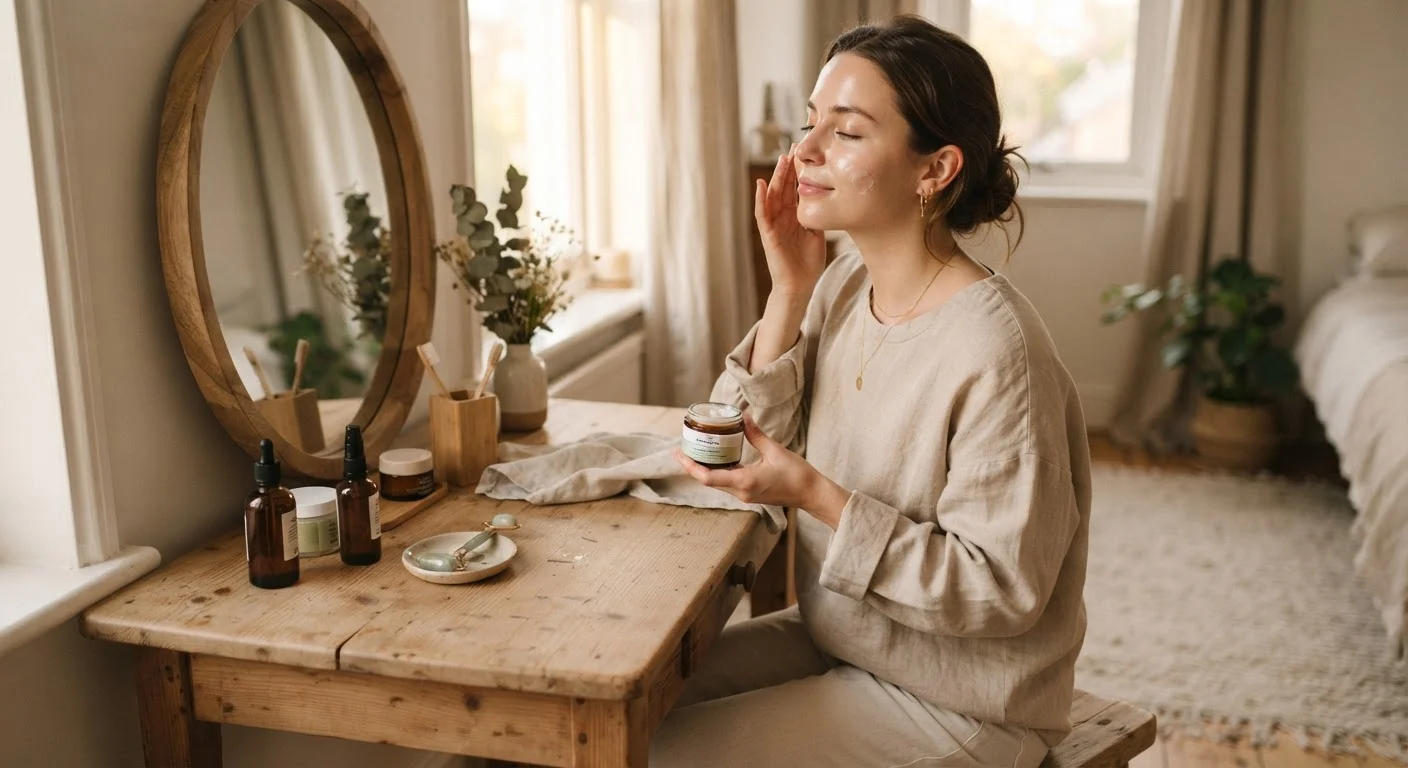
When you care for your skin, hair, or body because it reflects how you value yourself — not because you're chasing a standard set by a filtered image — the activity becomes self-reinforcing rather than comparison-driven. Values-based self-care builds intrinsic motivation, which psychological research associates with more sustainable habit formation.
Establish media-free windows during self-care time
Scrolling while applying a face mask or doing your hair brings the comparison environment directly into what could be a restorative practice. Separating digital consumption from embodied self-care protects the psychological benefits of both. For a broader look at this balance, see our article on the emotional pros and cons of high-investment self-care.
Practice lateral and downward reframing with compassion, not judgment
Actively shifting your attention toward people facing more challenging circumstances — or toward your own past self — can recalibrate your comparison baseline. Importantly, this works best when approached with genuine compassion rather than dismissiveness. The goal is perspective, not self-congratulation.
Seek out communities that center well-being over aesthetics
The social environments we inhabit — online and offline — set norms for what is valued and discussed. Communities organized around skin health, mindful living, or emotional wellness tend to foster supportive rather than competitive dynamics. Social connection, when health-affirming, is itself a documented protective factor. See how social connection functions as a preventive health factor.
Turning Self-Care Into a Psychological Anchor
The distinction between self-care as performance and self-care as practice is psychologically significant. When beauty routines are motivated by wanting to match an external ideal, they can amplify comparison anxiety. When they are oriented around sensory pleasure, physical care, and personal ritual, they tend to support emotional regulation instead.
A consistent morning skincare routine, for example, can function as a grounding cue — signaling to your nervous system that this time is yours, separate from the demands of social evaluation. This is explored in depth in our article on skincare as emotional anchoring. Sensory engagement — the warmth of water, the texture of a cleanser, the scent of a face oil — further supports this effect, as discussed in our piece on sensory self-care and mood regulation.
This article is for general informational purposes only and does not constitute medical or mental health advice. If you are experiencing persistent distress related to body image or self-worth, please consult a qualified healthcare or mental health professional.