

Key Takeaways
The Appeal of DIY Masks — and Why It Deserves a Closer Look
The idea of a face mask made from ingredients already in your kitchen carries an obvious appeal: it feels wholesome, cost-conscious, and free from synthetic additives. For readers exploring ingredient-conscious beauty routines, the pantry can seem like a logical starting point.
But your skin is not a salad. Edibility does not equal skin compatibility. The concentration, pH, and molecular structure of a food can make it nourishing internally yet disruptive when left on the delicate, barrier-dependent surface of your face. Understanding the distinction is the foundation of genuinely informed DIY skincare.
Below, we walk through the most common mistakes people make with kitchen-based masks — what drives them, and what to do instead.
Applying undiluted lemon juice directly to the face as a brightening mask.
Why it happens: Lemon juice is widely associated with brightening and vitamin C, making it seem like a logical shortcut for dull or uneven skin tone.
Using baking soda as an exfoliant or mask base to "balance" oily skin.
Why it happens: Baking soda is a household staple associated with cleaning and odor neutralization, which leads many people to assume it will "deep clean" pores.
Leaving apple cider vinegar on the skin as a "toning" or acne-clearing mask.
Why it happens: Apple cider vinegar has gained attention in wellness communities for its purported antimicrobial properties, leading people to apply it undiluted or in high concentrations directly to skin.
Using egg whites as a pore-tightening mask without considering hygiene risks.
Why it happens: Egg whites temporarily create a tightening sensation on skin, which is often interpreted as a sign that pores are being "closed" or "minimized."
Assuming a DIY mask is safe because it caused no immediate reaction the first time.
Why it happens: People often equate the absence of an immediate sting or redness with safety, not realizing that skin sensitization can develop gradually over repeated exposures.
Which Kitchen Ingredients Actually Have Evidence Behind Them
Not every pantry staple is a problem. A handful of common ingredients have a reasonable body of research or clinical tradition supporting their topical use — with appropriate caveats.
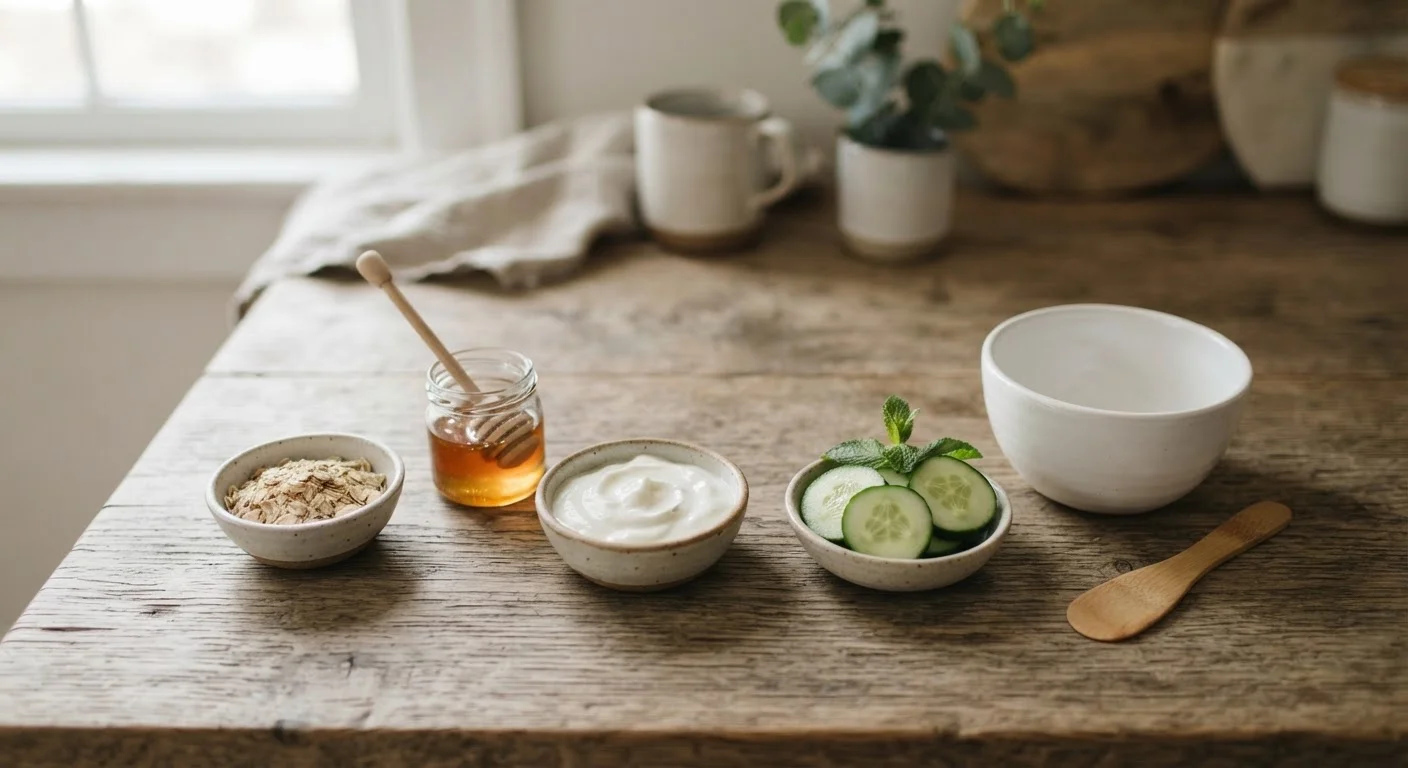
- Plain oats (colloidal oatmeal): Finely ground oatmeal is a well-studied skin-soothing ingredient, recognized by dermatologists for its ability to support the skin barrier and calm mild irritation. It is gentle enough for sensitive skin when used as a mask base.
- Raw honey: Honey has documented antimicrobial properties and a long history of wound-care use. As a mask ingredient, it can provide humectant (moisture-attracting) effects. Manuka honey has been more extensively studied, though raw honey of various types shows some evidence of skin benefit.
- Plain full-fat yogurt: Contains lactic acid, a gentle alpha hydroxy acid (AHA) that can support mild exfoliation. Concentrations in yogurt are low, making it less irritating than concentrated AHA products — though those with dairy sensitivities or reactive skin should approach cautiously.
Even these better-supported options carry individual variation. What soothes one person's skin may trigger a reaction in another. For a broader look at how ingredients interact, our guide to ingredient combinations is a useful reference.
~4.5–5.5
Healthy skin surface pH range
Dermatological references consistently cite this slightly acidic range as optimal for maintaining the skin's protective barrier function.
~2
pH of undiluted lemon juice
This extreme acidity — far below healthy skin pH — explains why direct citrus juice application commonly causes irritation and photosensitivity reactions.
Protecting Your Skin Barrier: The Non-Negotiables
Whatever ingredients you choose to experiment with, three principles consistently matter:
- Patch test first. Apply a small amount to your inner forearm or behind the ear and wait 24 hours before applying to your face. This simple step catches sensitivities before they become a full-face problem.
- Mind the contact time. Even skin-friendly ingredients can cause issues if left on too long. Limit DIY masks to 10–15 minutes unless you have specific guidance suggesting otherwise.
- Know when to stop. Stinging, burning, redness, or breakouts following a DIY mask are signals to discontinue use — not push through. If reactions persist, consult a dermatologist or licensed esthetician.
It is also worth understanding that the broader "natural is always safer" assumption deserves scrutiny. Our related piece on natural beauty myths explores how this framing can lead to uninformed choices — and what skin science actually says. For a more complete picture of ingredient safety across your full routine, ingredients worth watching in personal care products offers helpful context.
This article is for general informational and educational purposes only. It is not a substitute for professional medical or dermatological advice. If you have a skin condition, allergy history, or persistent reaction to any topical product, consult a qualified healthcare provider or board-certified dermatologist.