

Key Takeaways
Skin Barrier
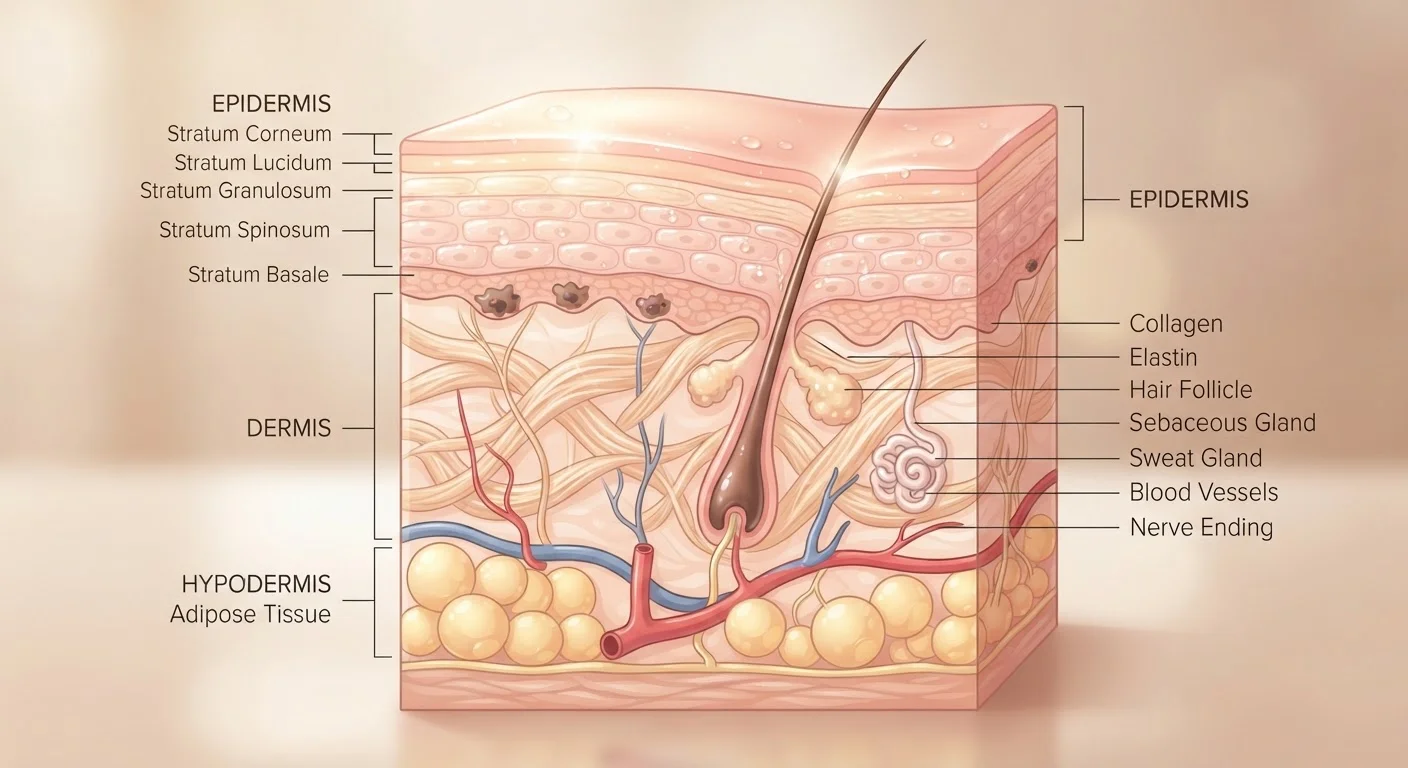
The skin barrier — formally called the stratum corneum — is the outermost layer of your skin. It acts like a protective wall, keeping moisture in and harmful elements like bacteria, pollutants, and irritants out. Think of it as a tightly packed arrangement of skin cells held together by lipids (fats), forming a seal that regulates what enters and leaves your body.
The skin barrier functions via a 'brick and mortar' model: corneocytes (the bricks) are embedded in a lipid matrix (the mortar) composed primarily of ceramides, cholesterol, and free fatty acids — each playing a distinct structural role.
What the Skin Barrier Actually Does
The skin barrier doesn't get the attention it deserves — most skincare conversations leap straight to serums, actives, and treatments. But no ingredient works optimally on a compromised foundation. The skin barrier is that foundation.
Its primary job is twofold: retain water and exclude threats. When it's functioning well, skin feels comfortable, looks even, and responds predictably to products. When it's weakened, even gentle formulas can sting, moisture evaporates faster than it can be replenished, and the skin becomes a less effective shield against bacteria and environmental pollutants.
The barrier also plays a role in whole-body health that extends beyond aesthetics. Chronic barrier disruption is associated with conditions like eczema and atopic dermatitis, where systemic inflammation is part of the picture. Understanding this connection — between skin surface health and broader physiological function — is why the skin care basics conversation always starts here.
~50%
Ceramide share of skin's lipid matrix
Ceramides account for approximately half of the lipid content in the stratum corneum, according to established dermatological literature on skin barrier composition.
4.5–5.5
Healthy skin surface pH range
The skin's slightly acidic pH is essential for barrier enzyme activity and microbiome balance — disruption by alkaline products is a well-documented cause of barrier impairment.
3–4 weeks
Typical barrier recovery timeframe
Skin cell turnover occurs roughly every 28 days in adults, meaning meaningful barrier repair generally requires several weeks of consistent, supportive care.
What Disrupts the Skin Barrier
Barrier damage is remarkably common, and often self-inflicted — not out of negligence, but out of enthusiasm for skincare that tips into overuse. Common routine errors like over-cleansing, layering too many actives, or using products with an incompatible pH can all strip the lipid mortar that holds the barrier together.
Key disruptors include:
- Harsh surfactants in cleansers that remove protective lipids alongside dirt
- Overuse of exfoliating acids or retinoids without adequate recovery time
- Low humidity environments and prolonged hot water exposure
- Fragrance and alcohol-based products, which can irritate lipid-depleted skin
- UV radiation, which degrades structural proteins and lipids over time
Environmental stressors compound lifestyle factors. Pollution, temperature extremes, and seasonal changes all exert pressure on the barrier daily — which is why routine consistency matters as much as product selection.
Less Is Often More for Barrier Recovery
If your skin feels reactive or irritated, consider pausing non-essential actives and returning to a simple cleanse-moisturise-SPF routine for two to four weeks. Giving the barrier a window of low-stress conditions is frequently the most effective first step in recovery — before introducing any new treatment ingredients.
The Ingredients That Actually Support Barrier Repair
Barrier-supportive skincare works by replenishing or mimicking the skin's own lipid composition. Three categories of ingredients are most relevant:
- Ceramides
- Naturally occurring lipids that make up roughly 50% of the skin's extracellular matrix. Topical ceramides — particularly ceramide NP, AP, and EOP — help restore the barrier's structural integrity. They're among the most evidence-backed ingredients in barrier repair.
- Fatty acids
- Including linoleic acid and oleic acid, these support the lipid bilayer. Plant-derived oils like rosehip, sea buckthorn, and oat oil provide fatty acid profiles that align well with skin's natural composition — making them useful additions to barrier-focused routines.
- Cholesterol
- Often overlooked in skincare, cholesterol works synergistically with ceramides and fatty acids. Research suggests these three lipids are most effective when present in an approximately balanced ratio.
Humectants like glycerin and hyaluronic acid complement this by drawing water into the upper skin layers, while occlusives like shea butter and plant-based waxes help seal moisture in. Understanding how these categories work together makes reading an ingredient label a genuinely useful skill rather than an overwhelming exercise.
“The skin barrier is not just a passive wall — it is an active, dynamic system that responds continuously to what we apply to it, what we eat, and the environment we live in. Respecting that complexity is the foundation of intelligent skincare.”
— Dr. Zoe Draelos, Dermatologist and clinical researcher specialising in cosmetic dermatology
Building a Barrier-Conscious Routine
Barrier health isn't achieved by adding more — it's often restored by doing less, more thoughtfully. A simplified routine built around cleansing, moisturising, and sun protection, using well-tolerated ingredients, consistently outperforms a complex regimen applied inconsistently or aggressively.
Some practical principles worth following:
- Cleanse with a low-stripping, pH-appropriate formula — ideally close to the skin's natural pH of around 4.5 to 5.5.
- Apply a barrier-supporting moisturiser while skin is still slightly damp to aid absorption.
- Introduce active ingredients like retinoids or exfoliating acids slowly, with rest days built in.
- Prioritise daily broad-spectrum sun protection — UV is one of the most consistent external sources of barrier degradation.
If your skin frequently feels reactive, tight, or unpredictably sensitive, it may help to distinguish between inherently sensitive skin and sensitised skin — the two conditions have different origins and respond to different approaches.
A consistent, gentle routine also carries psychological value. As explored in the relationship between skincare and self-respect, rituals that honour your skin can serve as meaningful anchors in a broader wellness practice — not just cosmetic maintenance.
This article is for informational purposes only and does not constitute medical advice. If you are experiencing persistent skin concerns, please consult a qualified dermatologist or healthcare professional.