

Key Takeaways
Why Everyday Movement Matters More Than You Think
The dominant image of exercise—a gym, a membership card, a dedicated hour—leaves a lot of people out. But research on Non-Exercise Activity Thermogenesis (NEAT) makes a compelling case that the movement woven into ordinary life contributes meaningfully to physical health. NEAT refers to the energy your body expends during all activity that isn't formal exercise: carrying groceries, pacing while on a phone call, folding laundry. For many people, this category rivals or exceeds the calorie burn of structured workouts.
The activities below require no equipment, no commute, and no fitness experience. They're organized around a simple premise: movement is most sustainable when it fits your actual life. If you're curious how much activity you're already getting, a daily movement audit can help you map the gaps and the wins already in your day.
This article is for general informational purposes only and is not a substitute for professional medical advice. Always consult a qualified healthcare provider before starting any new physical activity, especially if you have an existing health condition.
Stair Climbing
If your home, office building, or apartment complex has stairs, you have access to one of the most efficient low-impact cardiovascular tools available. Stair climbing elevates heart rate, engages the glutes, quads, and calves, and improves lower-body strength—all without the joint stress of running. Even two or three flights taken deliberately, multiple times a day, add up. The key is treating the stairs as a default rather than an option: skip the elevator as a standing rule rather than a situational choice.
Stairs are one of the most efficient low-impact cardiovascular tools available—no equipment needed.
Walking with Purpose
Walking is genuinely underrated as a form of exercise. It's weight-bearing (which supports bone density), rhythmic (which has documented mood-regulating effects), and accessible to nearly every fitness level. The goal isn't a single long walk—it's accumulation. Walking to a farther parking spot, taking a ten-minute loop after lunch, or pacing during phone calls all contribute. For those interested in the mindfulness dimension, movement-based meditation practices offer a way to turn a walk into a dual-purpose habit.
Walking is weight-bearing, mood-regulating, and accessible to nearly every fitness level.
Kitchen and Counter Stretches
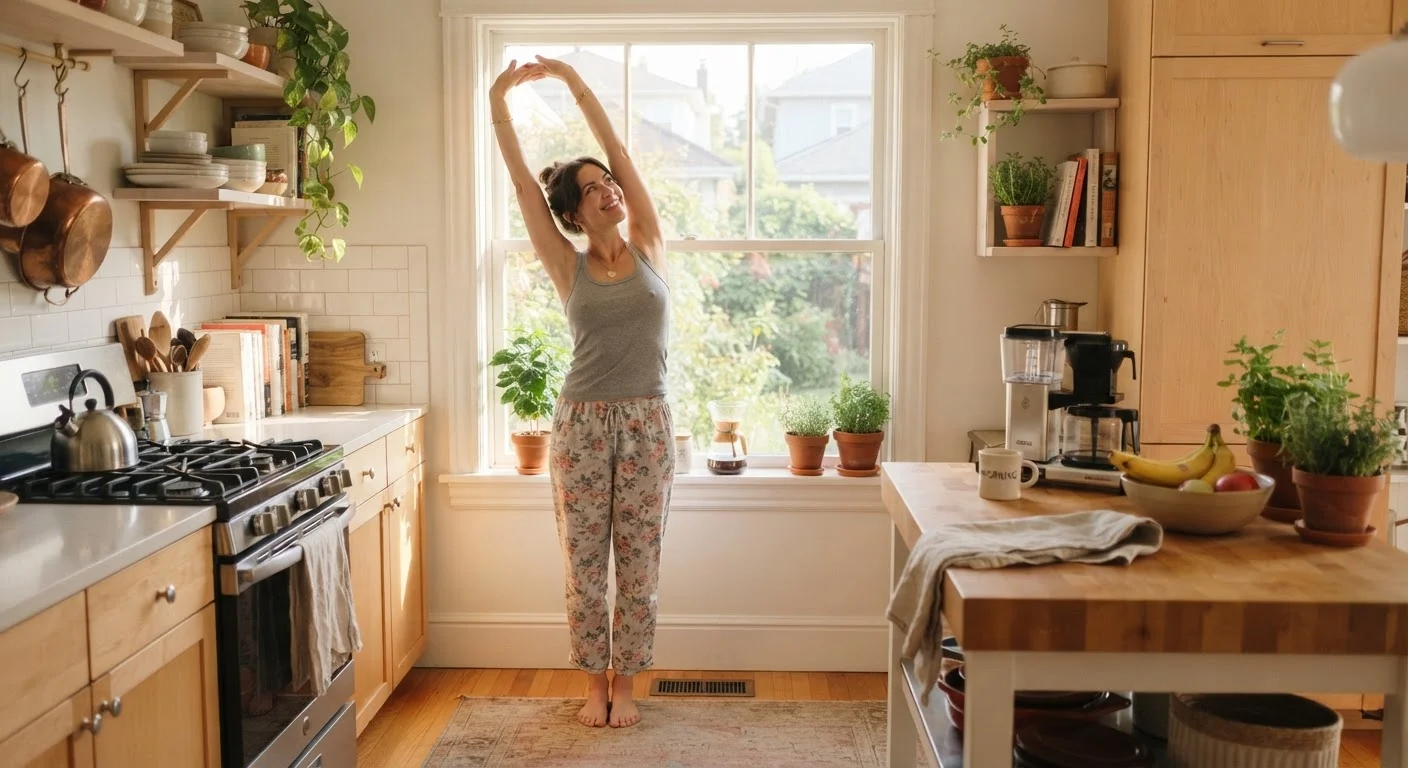
The kitchen is an underused movement space. Time spent waiting for water to boil or toast to pop is time that can involve calf raises, standing hip hinges, shoulder rolls, or a simple forward fold holding the counter for balance. These micro-stretches improve circulation, reduce the stiffness that builds from prolonged sitting, and take no additional time out of your day. The friction is essentially zero—you're already standing there.
Micro-stretches during kitchen waits take no extra time and meaningfully reduce seated stiffness.
Gardening and Yard Tasks
Gardening is a physically demanding activity that rarely gets credit as exercise. Digging, weeding, planting, raking, and hauling bags of mulch engage the core, arms, legs, and back in functional movement patterns. Research has linked regular gardening to improvements in strength, flexibility, and even mental health outcomes. If you have outdoor space—even a small container garden—tending it consistently adds genuine physical work to your week in a form that many people find intrinsically rewarding.
Gardening engages the core, arms, and legs in functional movement patterns with real fitness benefits.
Active Household Chores
Vacuuming, mopping, scrubbing bathrooms, making beds, and carrying laundry baskets between floors all qualify as physical activity under the NEAT framework. The difference between doing chores passively and doing them actively is intentionality: moving briskly, using full arm extension, squatting rather than bending at the waist. None of this requires slowing down your cleaning routine—it's a posture and pace adjustment that turns unavoidable tasks into movement sessions. Learn more about how these everyday activities register in the body in our explainer on NEAT.
Intentional posture and brisk pace turn unavoidable chores into genuine movement sessions.
Bodyweight Movements During Screen Time
Television, video calls, and podcast listening don't require stillness. Sitting on the floor and doing gentle hip openers, doing wall sits during commercial breaks, or holding a plank for the duration of a song are all viable. These aren't substitutes for dedicated training but they meaningfully interrupt extended sedentary periods—which research suggests carry independent health risks even among people who exercise regularly. The habit is simply: whenever a screen is on, some part of the body is moving.
Interrupting sedentary screen time with brief bodyweight movements carries independent health benefits.
Making It Stick: From One-Off Moves to Real Habits
Knowing what to do is only half the challenge. The harder part is doing it consistently when motivation dips—which it always does. One evidence-backed approach is habit stacking: attaching a new behavior to something you already do reliably. Stretch while the coffee brews. Walk during your lunch break before eating. Do calf raises every time you stand at the kitchen counter. These anchors remove the need for a fresh decision each time. Our guide to habit stacking for daily movement walks through how to build these pairings systematically.
Start With One Anchor, Not Six
Trying to overhaul your daily movement all at once is a reliable path to burnout. Choose one activity from this list and attach it to something you already do every day—a meal, a morning routine, a regular phone call. Once that feels automatic (typically after several weeks of consistency), add a second. Gradual layering is far more durable than ambitious overhauls.
If mornings feel like the most realistic window for movement, starting active before noon doesn't require a workout—just intentional choices made early. And for those whose days feel genuinely packed, weaving activity into a packed schedule offers strategies that work within existing transitions rather than requiring new time blocks. The goal isn't perfection—it's accumulation. Small movements, repeated daily, compound into a meaningfully more active life.