

Key Takeaways
Our Verdict
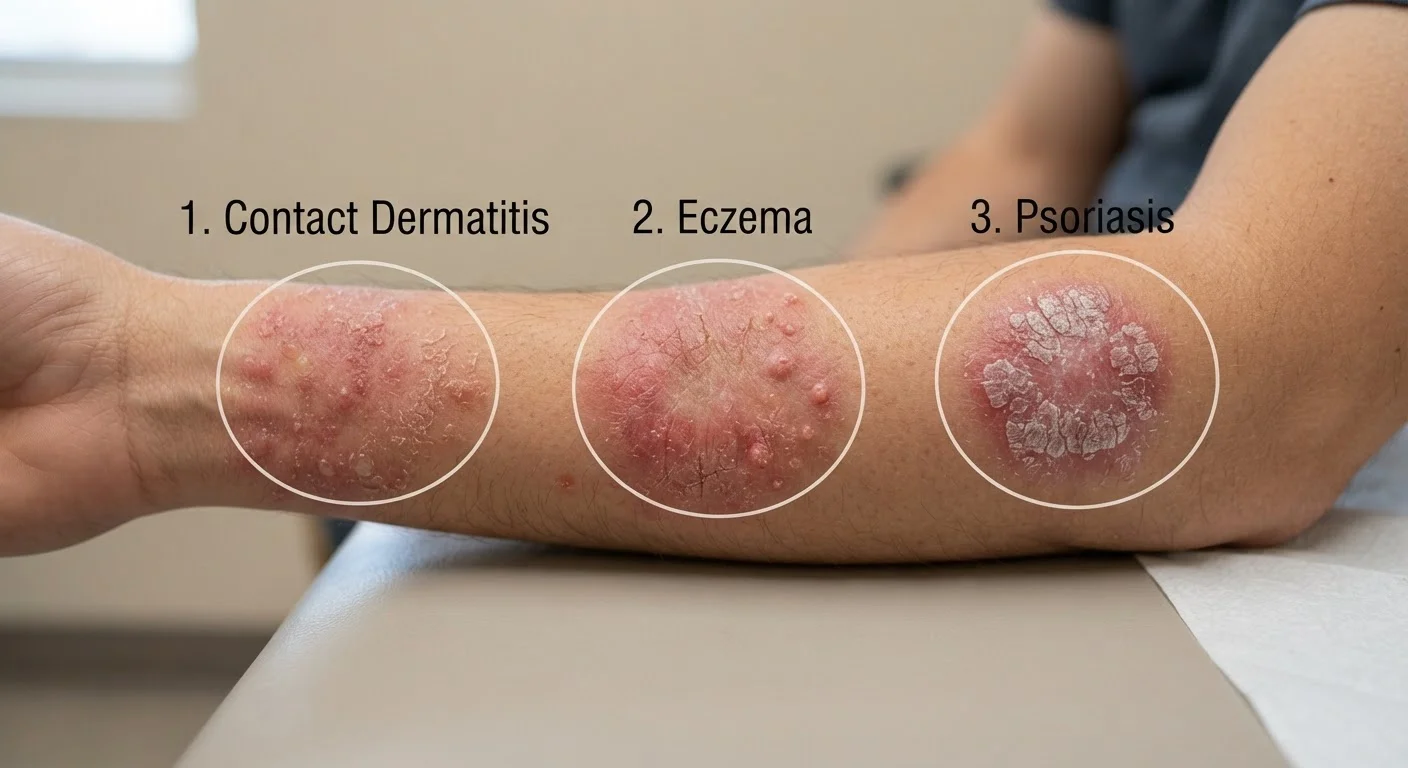
While eczema, psoriasis, and contact dermatitis can all produce visually similar rashes, they differ fundamentally in cause, body distribution, and management approach. Self-identification is unreliable — a dermatologist or physician can distinguish these conditions through clinical examination, history, and sometimes patch testing or biopsy.
| Best for | Recommended |
|---|---|
| Those experiencing chronic, recurring itchy rashes since childhood | Evaluation for eczema (atopic dermatitis) |
| Those with thick, silvery-scaled patches and possible joint symptoms | Evaluation for psoriasis |
| Those whose rash appears shortly after contact with a specific substance | Evaluation for contact dermatitis |
Why These Three Conditions Are So Often Confused
Redness, itching, and flaking are hallmarks of all three — eczema (atopic dermatitis), psoriasis, and contact dermatitis. Because the visual overlap can be significant, many people spend months managing the wrong condition before receiving an accurate diagnosis. Understanding the distinct fingerprints of each condition helps set realistic expectations and frames better conversations with clinicians.
These conditions are among the most common reasons adults visit a dermatologist in the United States. According to the American Academy of Dermatology, eczema affects over 31 million Americans, psoriasis affects roughly 7.5 million, and contact dermatitis is one of the leading causes of occupational skin disease. None of them are contagious, and all three are manageable — though the management paths differ considerably.
For a broader look at which skin changes warrant professional evaluation, see when to bring skin changes to your doctor.
| Eczema (Atopic Dermatitis) | Psoriasis | Contact Dermatitis | |
|---|---|---|---|
| Underlying cause | Skin barrier dysfunction + immune overreaction | Autoimmune — accelerated skin cell turnover | Reaction to irritant or allergen |
| Typical appearance | Dry, red/ashy itchy patches; may weep | Thick silvery-white scales on red plaques | Redness, blistering at contact site |
| Common locations | Elbow creases, knees, neck, face | Scalp, elbows, knees, lower back | Wherever the trigger contacts skin |
| Itch intensity | Often severe | Moderate; varies by person | Moderate to severe |
| Age of onset | Often childhood; can be adult-onset | Usually 15–35 or 50–60 | Any age after sensitization occurs |
| Key management focus | Barrier repair, trigger avoidance | Systemic/immune modulation, phototherapy | Identify and eliminate trigger substance |
Eczema: A Barrier and Immune System Problem
Eczema — most commonly the atopic form — stems from a combination of a weakened skin barrier and an overactive immune response. The skin fails to retain adequate moisture and becomes vulnerable to environmental triggers, setting off cycles of inflammation and intense itching. It frequently first appears in infancy or early childhood, though adult-onset eczema is not uncommon.
Characteristic features include dry, intensely itchy patches that tend to appear in the creases of the elbows, behind the knees, on the neck, and around the eyes. In darker skin tones, affected areas may appear brown, purple, or ashy rather than red. Flares are often triggered by dry weather, sweat, certain fabrics, soaps, stress, or allergens. Many people with eczema also have asthma or hay fever — a pattern clinicians call the "atopic triad."
Management typically focuses on consistent moisturizing to restore the skin barrier, identifying and avoiding personal triggers, and using topical anti-inflammatory treatments during flares under medical guidance. Understanding the difference between sensitive and sensitised skin can also help those managing eczema make more informed skincare choices.
Track Your Flares to Help Your Doctor
Keeping a simple log of when your skin reacts, what products or environments preceded it, and where on your body it appears gives your clinician far more to work with than memory alone. Photos taken during flares can be especially useful, since skin often looks different by the time of an appointment. Note stress levels, diet changes, and weather conditions too — patterns can emerge that point clearly toward one condition over another.
Psoriasis: An Autoimmune Condition With Systemic Dimensions
Psoriasis is fundamentally an autoimmune condition. The immune system mistakenly accelerates the skin cell lifecycle — cells that normally mature over weeks instead do so in days, accumulating on the surface as thick, silvery-white scales over inflamed red or pink skin. Plaque psoriasis is the most common form, typically affecting the scalp, lower back, elbows, and knees.
Unlike eczema, psoriasis often has a sharper, more defined border around plaques and is not always intensely itchy — though it can be. It is also associated with psoriatic arthritis in a meaningful subset of patients, with joint pain, stiffness, and swelling occurring alongside skin symptoms. Triggers commonly include stress, infections, certain medications, and skin injury.
Because psoriasis has systemic implications — including elevated risk of cardiovascular disease and metabolic syndrome in some research — its management goes beyond topical care. Treatment ranges from topical agents and phototherapy to systemic medications and biologics, always under specialist supervision. Just as osteoarthritis and rheumatoid arthritis share a name but diverge in mechanism (read that comparison here), psoriasis and eczema share visible similarities but require meaningfully different clinical approaches.
Contact Dermatitis: A Reaction to What Touches Your Skin
Contact dermatitis is the most situationally straightforward of the three — it develops when the skin reacts to something it has come into direct contact with. There are two types: irritant contact dermatitis, caused by physical or chemical damage (from harsh cleansers, solvents, or repeated wet work), and allergic contact dermatitis, an immune-mediated response to specific substances such as nickel, latex, fragrances, or preservatives.
The rash typically appears at the site of contact and may range from mild redness and scaling to blistering and weeping. Crucially, allergic contact dermatitis can develop to substances that previously caused no reaction — sensitization can occur after months or years of exposure. Patch testing performed by a dermatologist or allergist is the standard method for identifying culprit allergens.
Management centers on identifying and eliminating the offending substance. Once the trigger is removed, most cases resolve without long-term treatment, though topical corticosteroids are commonly used in the short term to reduce inflammation under medical guidance. Tracking skin behavior systematically — as outlined in our weekly skincare audit guide — can help pinpoint new product reactions early.
This article is for general informational purposes only and does not constitute medical advice. Always consult a qualified healthcare professional for diagnosis, treatment, or any questions regarding a medical condition.