

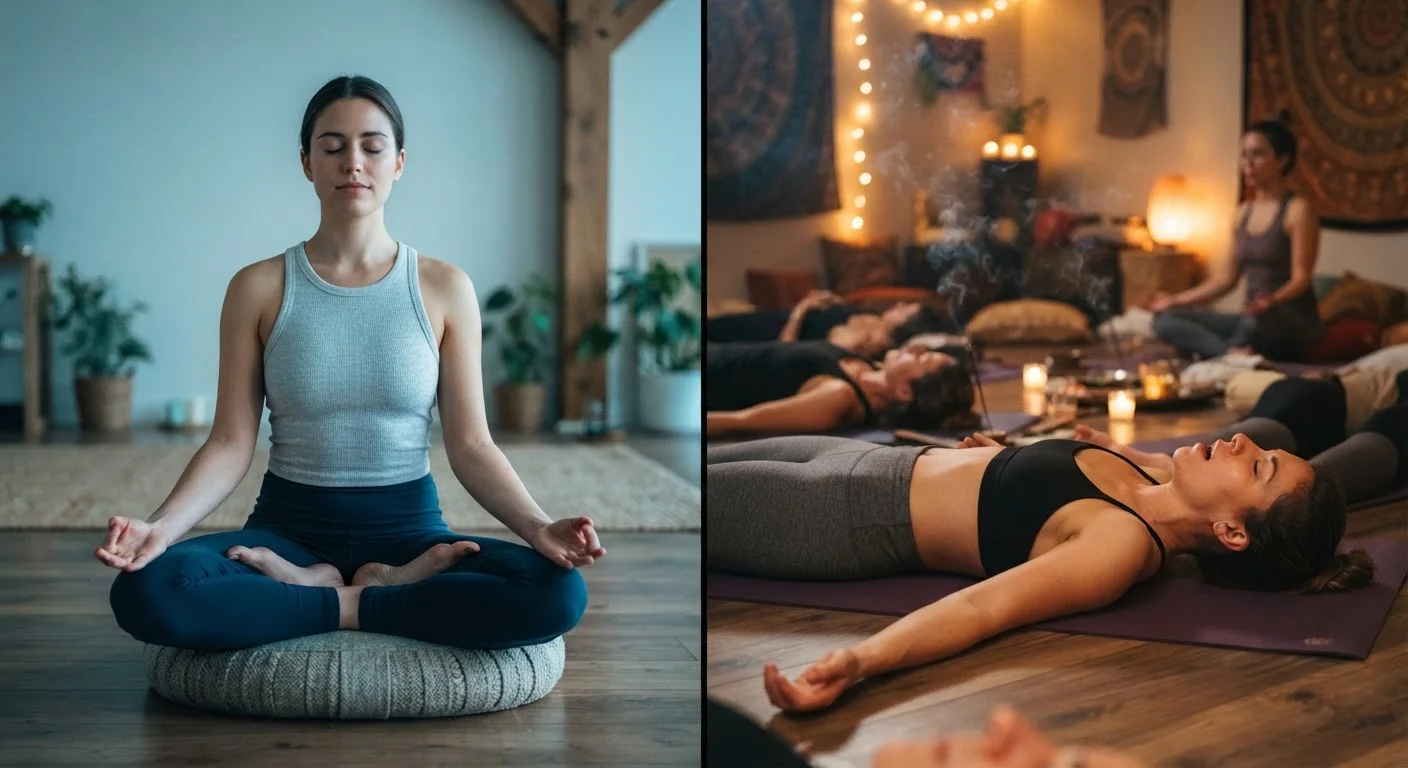
Key Takeaways
Option A
Coherent Breathing
The gentle, science-backed rhythm for everyday calm.
Best for: People seeking a low-risk, daily practice to regulate the nervous system and reduce stress.
Option B
Holotropic Breathwork
The immersive, altered-state experience for deep psychological exploration.
Best for: Those pursuing profound emotional processing or personal insight in a structured, facilitated setting.
If you want a daily stress-management tool you can practice alone
Coherent Breathing
Its gentle pace and low physiological demand make it safe and sustainable as an everyday habit with minimal supervision needed.
If you're seeking a structured, facilitated experience for emotional processing
Holotropic Breathwork
The technique is specifically designed for deep psychological exploration and must be conducted with a certified facilitator in a controlled environment.
If you're new to breathwork and want to build a foundation first
Coherent Breathing
Starting with a gentle, evidence-grounded technique helps you understand your body's responses before attempting more intense approaches.
If you have a history of cardiovascular or respiratory conditions
Coherent Breathing
Holotropic breathwork's intensity is contraindicated for several medical conditions; coherent breathing's gentle rhythm is generally lower-risk, though medical clearance is still advisable.
What Each Practice Actually Is
Despite both involving deliberate breath control, coherent breathing and holotropic breathwork are fundamentally different in goal, intensity, and application. Understanding the distinction matters — choosing the wrong approach at the wrong time can range from ineffective to genuinely uncomfortable or unsafe.
Coherent breathing — sometimes called resonance breathing — involves slowing the breath to approximately five full cycles per minute (five seconds in, five seconds out). This pace is thought to synchronize the breath with the body's natural heart rate variability (HRV) rhythms, stimulating the vagus nerve and shifting the autonomic nervous system toward a parasympathetic, or "rest and digest," state. Researchers including Stephen Elliott have documented and popularized this approach, and a growing body of peer-reviewed literature supports its use for stress and anxiety regulation. It requires no special environment and can be practiced in minutes.
Holotropic breathwork was developed in the 1970s by psychiatrist Stanislav Grof and his wife Christina Grof as a non-pharmacological method to access non-ordinary states of consciousness. The technique involves sustained, accelerated breathing — significantly faster than normal — combined with evocative music and focused bodywork from trained facilitators. Sessions typically last two to three hours and are designed to surface unconscious material for psychological integration. This is not a casual or solo practice. See our complete breathwork reference for a broader map of where both techniques fit.
How They Work: The Physiology and Psychology
The mechanisms behind each practice point in very different directions.
Coherent breathing works primarily through the autonomic nervous system. Slowing the breath to five breaths per minute maximizes heart rate variability — the natural fluctuation in time between heartbeats — which is associated with greater emotional resilience and reduced physiological stress. Studies published in journals such as Applied Psychophysiology and Biofeedback have found associations between resonance-frequency breathing and reductions in anxiety and depressive symptoms, though researchers note that larger, more rigorous trials are still needed. The practice is low-effort, predictable, and the physiological response is generally mild and manageable.
Holotropic breathwork operates through a different mechanism: hyperventilation-induced altered states. Sustained rapid breathing lowers carbon dioxide levels in the blood (hypocapnia), which can produce tingling, light-headedness, involuntary muscle contractions, and, for many practitioners, vivid imagery and intense emotional experiences. Grof framed these states as windows into what he called "transpersonal" dimensions of experience. From a strictly physiological standpoint, the body is under meaningful stress during a session. This is why breathwork can feel overwhelming — and why holotropic sessions require medical screening beforehand.
| Criterion | Coherent Breathing | Holotropic Breathwork |
|---|---|---|
| Breathing pace | ~5 breaths per minute (slow) | Faster than normal (sustained) |
| Session length | 5–20 minutes, daily | 2–3 hours, occasional |
| State induced | Relaxed, calm alertness | Non-ordinary / altered state |
| Supervision needed | Can be self-guided | Certified facilitator required |
| Primary mechanism | HRV optimization, vagal tone | Hypocapnia-induced neurological shift |
| Risk level | Low for healthy adults | Moderate-high; medical screening required |
| Primary goal | Stress reduction, nervous system balance | Psychological exploration, emotional processing |
| Research base | Growing peer-reviewed evidence | Limited; largely qualitative and clinical reports |
Safety, Contraindications, and Who Should Avoid Each
Neither practice is entirely without risk, but they differ significantly in risk profile.
Coherent breathing is considered low-risk for the general healthy adult population. Because it does not push the body toward hyperventilation, it avoids many of the physiological extremes associated with intense breathwork. That said, individuals with severe respiratory conditions, heart arrhythmias, or acute anxiety disorders should consult a healthcare provider before beginning any structured breathing practice.
Holotropic breathwork carries a longer list of contraindications. Facilitators trained through Grof Transpersonal Training typically screen participants and exclude those with cardiovascular disease, epilepsy, a history of psychosis or schizophrenia, recent surgery, pregnancy, and several other conditions. The emotional intensity can also be destabilizing for individuals without adequate psychological support. This practice should never be attempted without a certified facilitator and appropriate screening. It is also worth reviewing common breathwork myths before either practice — misconceptions about what "counts" as breathwork often lead people to underestimate intensity differences like this one.
Special Populations: Consult a Professional First
Pregnant individuals, those with cardiovascular or respiratory conditions, people managing psychosis or bipolar disorder, and anyone with a recent surgical history should obtain explicit clearance from a qualified healthcare provider before attempting either practice. This is especially critical for holotropic breathwork, which has a longer contraindication list than most breathwork methods. When in doubt, err on the side of caution and begin with the guidance of a trained practitioner.
This article is for informational purposes only and is not a substitute for medical advice. Always consult a qualified healthcare professional before beginning any new breathing practice, particularly if you have a pre-existing physical or mental health condition.
Choosing Based on Your Goal
The clearest way to choose between these two practices is to identify your primary intention.
If your goal is daily stress regulation — lowering baseline anxiety, improving sleep, building resilience over weeks and months — coherent breathing is the more appropriate tool. It is teachable in a single session, requires no special equipment, and compounds in benefit with consistent use. Research on breathwork and mental clarity suggests that regular, gentle practices like coherent breathing may support cognitive function, though more research is ongoing.
If your goal is deep psychological exploration — processing grief, trauma, or questions of meaning — and you have already established a stable mental health foundation, holotropic breathwork may be worth exploring with a qualified facilitator. It is not a stress-management routine; it is an immersive, time-intensive process with a specific therapeutic context.
For those entirely new to conscious breathing, starting with coherent breathing builds body awareness and nervous system literacy — a foundation that makes any future exploration safer and more informed. You might also compare simpler structured rhythms with our guide to box breathing vs. 4-7-8 before stepping into more demanding territory.
~5 bpm
Optimal breath rate for HRV coherence
Research in applied psychophysiology identifies approximately five breaths per minute as the resonance frequency that maximizes heart rate variability in most adults.
2–3 hours
Typical holotropic breathwork session duration
Grof Transpersonal Training guidelines describe standard holotropic sessions as lasting two to three hours, including integration time.
1970s
Decade holotropic breathwork was developed
Stanislav Grof and Christina Grof developed holotropic breathwork in the 1970s as a legal alternative to psychedelic-assisted therapy following scheduling restrictions.