

Key Takeaways
Meditation
Meditation is a deliberate mental practice in which you train your attention and awareness over a set period of time. Rather than trying to stop thoughts, you practice noticing where your mind goes and gently returning focus to a chosen anchor — such as your breath, a sound, or a sensation. It is a skill developed through repetition, not a state you either achieve or don't.
In research literature, meditation is broadly categorized into focused attention (FA) practices, where attention is directed to a single object, and open monitoring (OM) practices, where awareness is expanded without a fixed focus.
What Meditation Actually Involves
Strip away the imagery of incense, lotus poses, and blissful silence, and meditation is straightforward: it is a deliberate practice of training attention. You choose an anchor for your focus — commonly the breath, but also a sound, a physical sensation, or a mental image — and you practice returning to it whenever your mind drifts elsewhere.
That last part is the core of it. The moment you notice your attention has wandered and bring it back, you are doing meditation correctly. It is less like achieving a mental state and more like doing repetitions at a gym — each return of attention is one rep, and the repetitions are the workout.
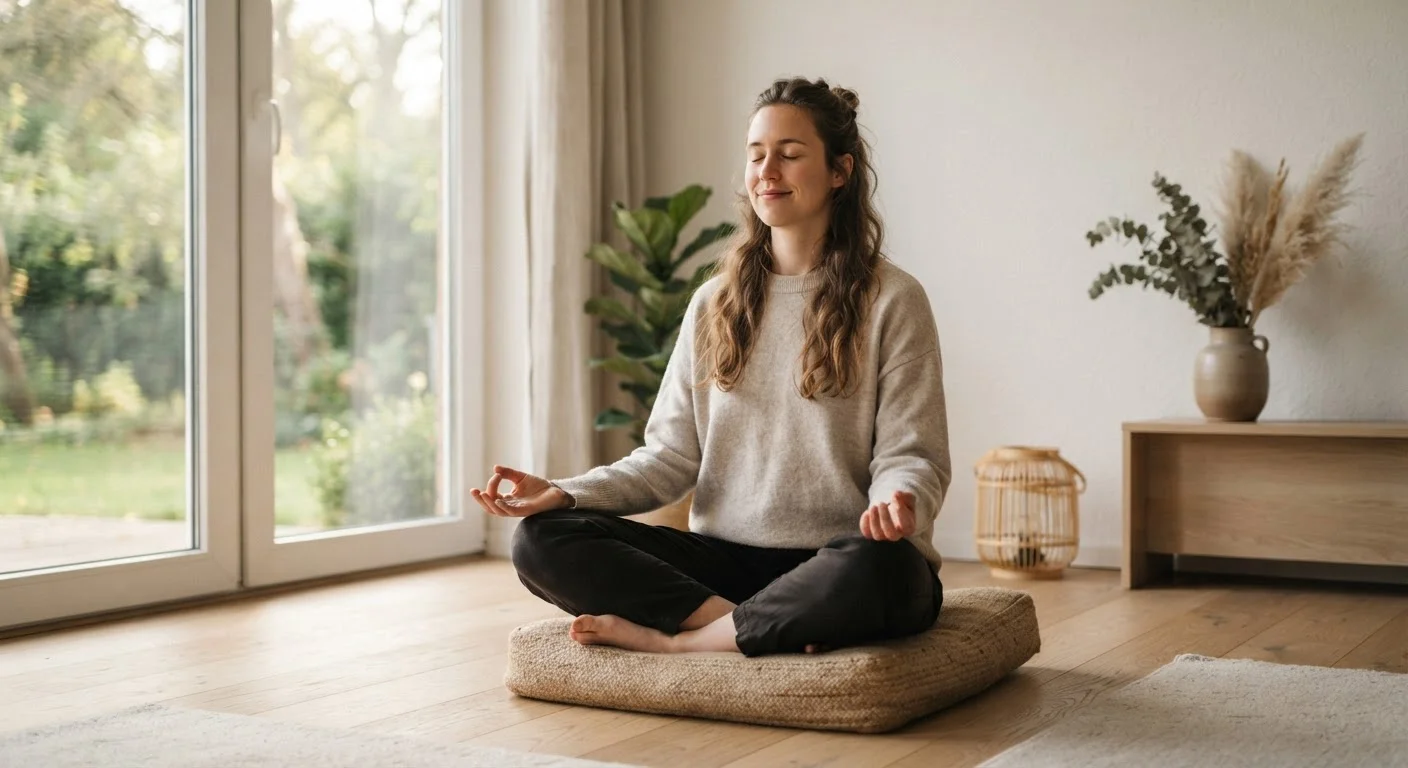
Most formal meditation sessions involve three basic elements: settling into a comfortable position, directing attention to the chosen anchor, and observing what happens with a non-judgmental attitude. Sessions can last anywhere from five minutes to an hour, though longer is not automatically more beneficial, especially for beginners.
Start With Just the Breath
If you are new to meditation, begin by simply paying attention to the physical sensation of breathing — the rise and fall of the chest or the feeling of air at the nostrils. When your mind wanders (it will), gently return without self-criticism. Even two to three minutes of this, practiced daily, is a legitimate starting point.
What Meditation Is Not
Several persistent myths make meditation feel out of reach for people who might otherwise benefit from it. The most widespread is that meditation requires a blank mind. It does not. Cognitive science tells us the mind generates thoughts continuously; expecting silence is like expecting your heart to stop beating while you rest. The practice is about relating to thoughts differently — noticing them, letting them pass, returning to the anchor — not eliminating them.
Meditation is also not exclusively a spiritual activity. While it is embedded in Buddhist, Hindu, and other traditions, secular versions have been studied extensively in clinical, educational, and occupational settings. You can practice meditation as a practical mental-fitness tool with no religious or spiritual framing required.
It is not a quick fix, a guaranteed cure for any condition, or a replacement for medical or psychological care. Research suggests that regular practice may support stress regulation, attention, and emotional awareness, but individual results vary, and meditation is best understood as one component of a broader approach to wellbeing. Always consult a qualified healthcare professional about specific health concerns.
Special Populations: Consult a Professional
For most healthy adults, basic mindfulness meditation carries a low risk profile. However, if you are managing trauma, a serious mental health condition, or a chronic illness, it is worth speaking with a qualified healthcare provider before beginning a new practice. Research on meditation in clinical contexts is ongoing, and guidance from a professional familiar with your history is always appropriate.
The Main Styles — Briefly Explained
Meditation is not a single technique. Different approaches suit different people and goals:
- Focused attention (FA) meditation — You direct awareness to one object, typically the breath, and gently return whenever the mind wanders. This is the most common entry point for beginners.
- Open monitoring (OM) meditation — Rather than a fixed focus, you hold a broad, receptive awareness of whatever arises — sounds, sensations, thoughts — without attaching to any of it. Often introduced after some FA experience.
- Body scan — Attention moves systematically through areas of the body, noting sensation without trying to change it. Widely used in mindfulness-based stress reduction (MBSR) programs.
- Loving-kindness (metta) meditation — Silent repetition of phrases wishing wellbeing to oneself and others. Associated in research with increases in positive affect and social connectedness.
For plain-language definitions of these terms and others, the meditation glossary is a useful starting point. A deeper look at how these approaches work is covered in Meditation from the Ground Up.
8 weeks
Minimum program length in landmark MBSR research
The original Mindfulness-Based Stress Reduction program developed at the University of Massachusetts used an eight-week structured format, the basis for much subsequent clinical research.
~13 min
Daily session length linked to attention improvement in one study
A 2018 study published in Psychological Science found that approximately 13 minutes of daily meditation over eight weeks was associated with improvements in attention and mood in novice meditators.
200+
Randomized controlled trials on mindfulness interventions
A 2018 meta-analysis in Perspectives on Psychological Science reviewed over 200 randomized controlled trials examining mindfulness-based programs across various health outcomes.
How to Think About Starting
The barrier to beginning is lower than most people assume. You do not need a cushion, a dedicated room, an app, or any prior experience. A chair with your feet flat on the floor is sufficient. A few minutes of uninterrupted time is enough to start.
What matters most is consistency over intensity. A five-minute daily practice maintained across weeks tends to build more durable habits than a single thirty-minute session done once. If you find yourself wondering whether you are doing it wrong, read through common meditation myths — many beginners share the same doubts, and most of them are unfounded.
Meditation is also distinct from mindful living more broadly. Sitting practice is a structured training ground; the awareness it builds can then extend into daily activities. If that distinction interests you, our article on what mindful living actually means explores it clearly.
This article is for general informational and educational purposes only and does not constitute medical or mental health advice. If you have concerns about your mental or physical health, please consult a qualified healthcare professional.