

Key Takeaways
Why Dermatologists Keep Coming Back to This One Habit
Skincare advice can feel overwhelming — layered serums, active ingredients, rotating routines. Yet across decades of dermatology research, one recommendation consistently rises above the rest: wear sunscreen every single day. Not just at the beach. Not just in summer. Every day.
The reason this habit commands such near-universal agreement among skin health professionals is simple: ultraviolet (UV) radiation is the most significant environmental stressor the skin faces, and its effects are cumulative. Each unprotected exposure adds to a lifelong total. As the evidence on preventive health habits shows, steady daily action outperforms occasional bursts of effort — and sunscreen is a perfect illustration of that principle at work on skin.
UV radiation falls into two main categories: UVA rays, which penetrate deeply and drive premature aging, and UVB rays, which are the primary cause of sunburn. Both contribute to DNA damage in skin cells and are associated with increased skin cancer risk. Broad-spectrum sunscreen is formulated to block both.
What Consistently Skipping SPF Actually Does to Skin
The consequences of skipping sunscreen are rarely dramatic on any single day — which is exactly why the habit is so easy to neglect. The damage accumulates quietly. Research published in peer-reviewed dermatology literature consistently links cumulative UV exposure to photoaging: the breakdown of collagen and elastin that produces fine lines, uneven pigmentation, and loss of skin firmness well before chronological aging would account for them.
~90%
Skin aging attributed to UV exposure
Dermatologists and researchers widely cite UV radiation as responsible for the majority of visible skin aging, including wrinkles and pigmentation changes.
SPF 30
Minimum recommended daily protection level
The American Academy of Dermatology recommends a minimum of SPF 30 broad-spectrum sunscreen for daily use on all exposed skin.
UVA rays are particularly deceptive. They penetrate cloud cover and glass, meaning a day spent near a window or driving delivers real UV exposure. People who commute regularly or work near windows often accumulate meaningful one-sided facial UV exposure over years without realizing it. This is one reason dermatologists recommend daily SPF as a baseline, not a situational precaution.
Beyond aesthetics, the health stakes are significant. Skin cancer is among the most commonly diagnosed cancers in the United States, and UV exposure is a primary modifiable risk factor. Daily sunscreen use has been shown in long-term studies to meaningfully reduce the risk of certain skin cancers when applied consistently. This positions sunscreen not just as a cosmetic choice but as a public health behavior — one that reframes daily self-care as an act of genuine self-respect.
How to Build the Habit Correctly
Knowing sunscreen matters and actually applying it every morning are two different things. Making the habit stick requires removing friction and understanding a few practical essentials.
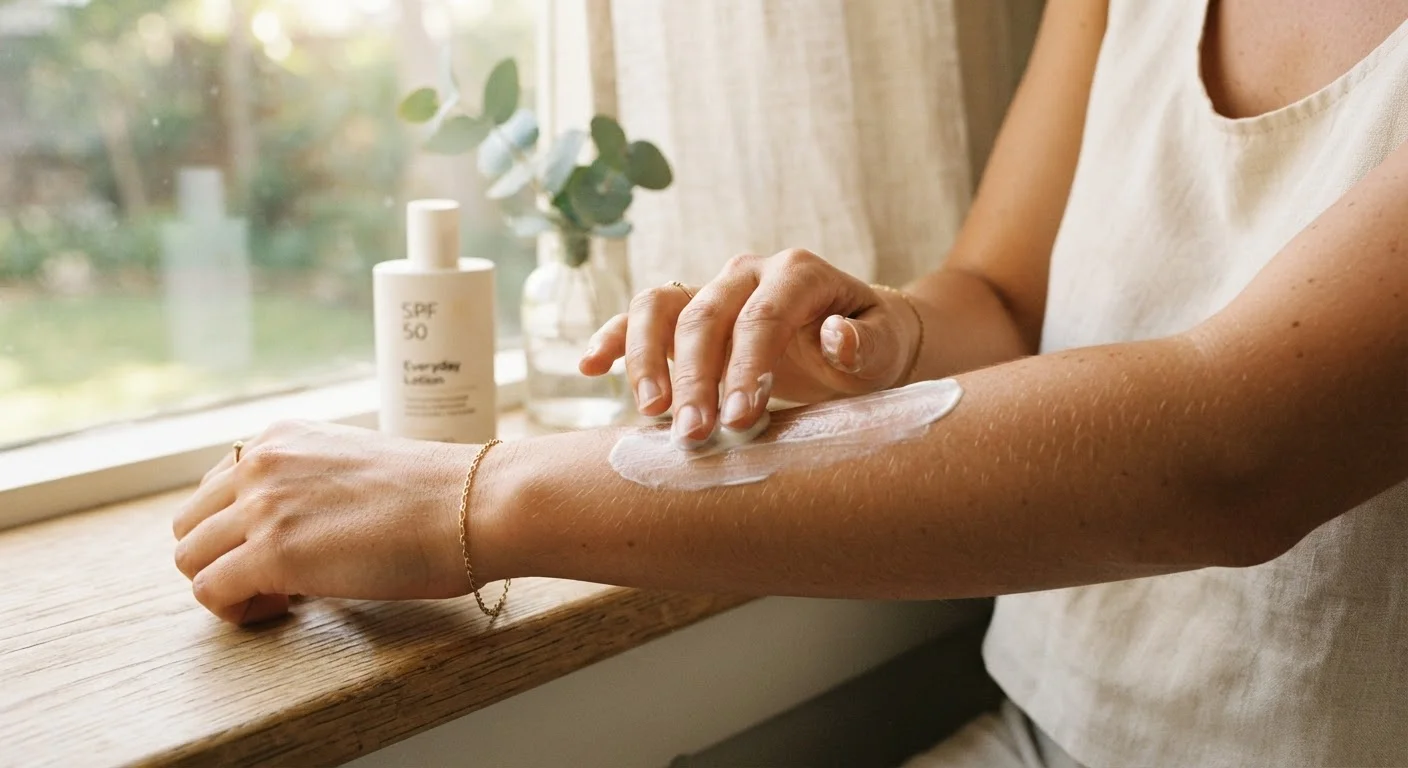
Choose a broad-spectrum SPF 30 or higher and apply it every morning as the final step of your skincare routine.
Broad-spectrum protection addresses both UVA and UVB rays. SPF 30 filters approximately 97% of UVB rays, and pairing it with a consistent morning placement cue — after moisturizer, before leaving the house — makes the habit automatic rather than a daily decision.
Apply enough — roughly a nickel-sized amount for the face alone — and don't forget the neck, ears, and hands.
Studies suggest most people apply far less sunscreen than the amount used in SPF testing, which means real-world protection is often lower than the label suggests. Application volume matters as much as SPF rating.
Reapply every two hours when spending extended time outdoors, or immediately after swimming or heavy perspiration.
Sunscreen degrades and rubs off over time. A morning application alone does not provide all-day protection during outdoor activity. Reapplication sustains the barrier that the initial application established.
Wear SPF on overcast and indoor days, especially if you spend time near windows.
UVA rays penetrate clouds and glass with minimal reduction. The skin does not distinguish between a beach afternoon and a cloudy commute — cumulative exposure accumulates in both scenarios.
Pair sunscreen with other protective habits — shade-seeking, protective clothing, and avoiding peak UV hours — rather than treating SPF as a complete solution alone.
Sunscreen is highly effective but not a perfect barrier at any SPF rating. A layered approach to UV protection reduces overall exposure more reliably than sunscreen alone, and avoids the false confidence that can lead to extended unprotected sun exposure.
It also helps to know that not all sunscreen formulas are identical in how they work. If you're weighing your options, our guide on chemical vs. physical sunscreen explains the differences and what to consider for different skin types.
One common barrier is the belief that sunscreen causes breakouts or feels too heavy for daily wear. Modern formulations have addressed many of these concerns — lightweight, non-comedogenic (meaning they don't clog pores) options exist across a wide range of textures. Finding a formula you enjoy wearing consistently matters more than chasing a theoretically perfect SPF number.
Be cautious of common misconceptions too — for example, the idea that a "natural" SPF is inherently safer or more effective. The evidence behind natural beauty claims is often more nuanced than marketing suggests.
This article is for general informational purposes only and does not constitute medical advice. Consult a qualified healthcare or dermatology professional for personalized guidance on skin health and sun protection.