

Key Takeaways
Active Commuting
Active commuting means traveling to and from work — or school — using human-powered movement rather than a motor vehicle. Walking and cycling are the most common forms, though running, skateboarding, and rowing are practiced in some contexts. The core idea is replacing a sedentary trip with one that counts toward your daily physical activity.
Public health researchers classify active commuting as a form of 'incidental physical activity' — movement that occurs as a byproduct of a necessary task rather than dedicated exercise. Studies published in journals such as the British Journal of Sports Medicine suggest it may carry independent cardiovascular benefits.
Why the Commute Is Underrated as a Health Opportunity
For most working adults, the daily commute is treated as dead time — something to endure before the day begins. But reframing it as a built-in movement window changes the equation significantly. Unlike a gym session that requires scheduling, motivation, and travel overhead, your commute happens regardless. The question is simply whether it involves your body.
Active commuting doesn't add time to your day in the same way a workout does. You're covering distance you were already going to cover. That distinction matters enormously for people who struggle to carve out separate exercise time — which, according to survey data from the CDC, is most American adults.
This approach fits naturally alongside habit stacking strategies — attaching movement to something you already do. The commute is perhaps the most reliable daily anchor available.
53%
U.S. adults not meeting activity guidelines
According to CDC physical activity data, more than half of American adults do not meet recommended aerobic activity targets — a gap that structured commuting movement can meaningfully address.
28%
Lower cardiovascular disease risk in cycling commuters
A large cohort study published in the British Medical Journal found that people who commuted by bicycle had notably lower rates of cardiovascular disease compared to non-active commuters.
~30 min
Average daily walking added by active commuters
Research on urban commuters suggests active commuters typically add at least 30 minutes of moderate physical activity per day compared to those who drive or take transit without walking.
What Active Commuting Actually Looks Like
The most common forms are walking and cycling, but active commuting exists on a spectrum. A full active commute means traveling the entire distance under your own power. A partial active commute — far more common and equally valid — involves combining human-powered movement with transit or driving.
- Walking the full route: Practical for shorter distances, typically under two miles. Requires the most time but has the lowest equipment barrier.
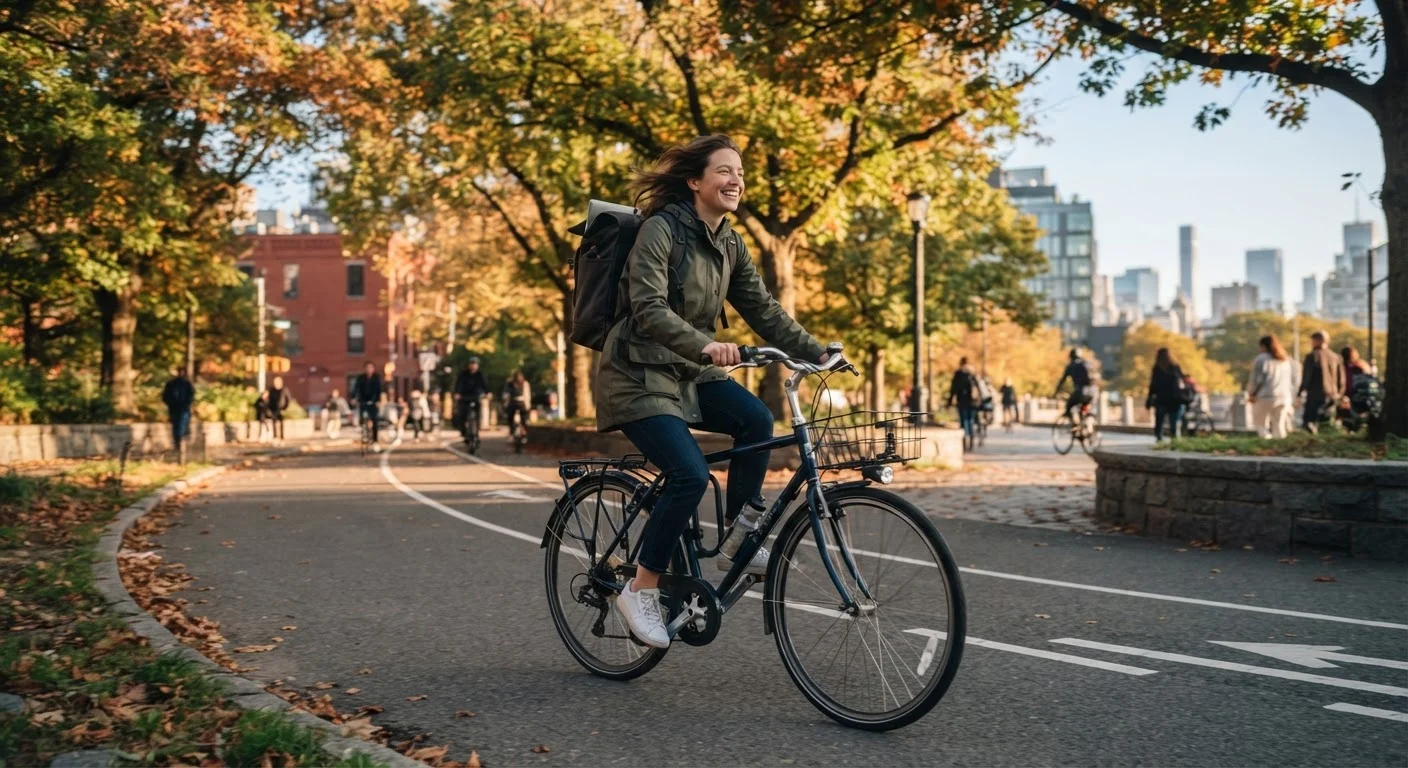
- Cycling part or all of the way: Extends your range considerably. Requires a safe route and basic gear, including a helmet.
- Transit plus walking: Exit a stop or two early, or walk to a farther station. A consistent 15-minute walk on each end adds 30 minutes of movement daily.
- Park-and-walk: Deliberately park farther from the office. Simple, low-commitment, and highly adaptable.
If you're interested in pairing movement with mindful awareness during this time, the practice of turning your commute into a mindfulness practice can complement the physical benefits considerably.
Common Barriers and How People Work Around Them
Active commuting has real obstacles, and acknowledging them honestly is more useful than pretending enthusiasm alone solves them.
Distance
The single most common reason people rule out active commuting is that their workplace is simply too far. The partial commute model addresses this directly — no rule says you must go car-free the entire route.
Safety and Infrastructure
Not every neighborhood has safe cycling lanes or well-lit walking paths. Mapping your route in advance — ideally by testing it on a weekend — lets you identify hazards before you're managing them under time pressure. Local cycling advocacy groups often publish recommended routes.
Arriving Presentable
Pace management helps: a walk at a conversational pace generates far less perspiration than a brisk jog. Some employers offer locker rooms or showers; it's worth asking directly rather than assuming the answer is no.
Weather
Layering appropriately and owning weather-specific gear — a packable rain jacket, thermal gloves — makes seasonal variability manageable rather than prohibitive. Many seasoned commuters maintain a fallback plan for genuinely hazardous days rather than aiming for perfect consistency.
Start With One Day, Not Five
Committing to active commuting every single day from the start is one of the most reliable ways to burn out quickly. Pick one or two days per week where conditions are most favorable — good weather, lighter schedule, no heavy bags — and treat those as your practice runs. Consistency over weeks matters far more than ambition in week one.
Building an Active Commute Into Your Routine
Starting gradually reduces the risk of abandoning the habit early. If you've never cycled to work, committing to one day per week is a realistic first target. Once that feels normal, adding a second day becomes far easier than overhauling your entire routine at once.
Active commuting pairs well with morning movement habits. If you're already working on starting active before noon, the commute becomes a natural extension of that momentum rather than a separate undertaking.
For those whose commutes truly prevent full active travel, low-impact alternatives throughout the day remain a practical complement. Active commuting is one strategy within a broader picture of daily movement — not a requirement for a healthy life, but for many people, a highly efficient one.
This article is for informational purposes only and does not constitute medical advice. Consult a qualified healthcare professional before making significant changes to your physical activity, especially if you have an existing health condition.