

| Sleep stages | 4 total: N1, N2, N3 (NREM), and REM |
| Cycle length | Approximately 90 minutes per full cycle (National Sleep Foundation) |
| Cycles per night | 4–6 cycles in a typical 7–9 hour night |
| Largest share of sleep | N2 (light sleep) — roughly 45–55% of total sleep time |
| Deep sleep concentration | Mostly in the first half of the night |
| REM concentration | Mostly in the second half of the night |
The Architecture of a Night's Sleep
Sleep is not a single, uniform state. Each night, your brain moves through a predictable sequence of stages — typically cycling through them four to six times over seven to nine hours. Understanding this structure helps explain why cutting sleep short, or fragmenting it with interruptions, leaves you feeling worse than the total hours alone would suggest.
Sleep is broadly divided into two categories: Non-REM (NREM) sleep and REM (Rapid Eye Movement) sleep. NREM is further subdivided into three stages — N1, N2, and N3 — each progressively deeper. One full cycle through these stages lasts roughly 90 minutes. Early cycles in the night are dominated by deep NREM sleep; later cycles shift toward longer REM periods. This is why the final two hours of sleep are disproportionately rich in REM — and why sleeping only six hours instead of eight cuts REM dramatically rather than proportionally.
For a broader look at what the body is doing across an entire night, see what happens to your body during a full night of sleep.
| Sleep stages | 4 total: N1, N2, N3 (NREM), and REM |
| Cycle length | Approximately 90 minutes per full cycle (National Sleep Foundation) |
| Cycles per night | 4–6 cycles in a typical 7–9 hour night |
| Largest share of sleep | N2 (light sleep) — roughly 45–55% of total sleep time |
| Deep sleep concentration | Mostly in the first half of the night |
| REM concentration | Mostly in the second half of the night |
What Happens in Each Stage
N1 — Light Sleep Onset
N1 is the transition between wakefulness and sleep, lasting just one to seven minutes. Brain activity slows from alert beta waves to slower alpha and theta waves. Muscle twitches are common, and the sleeper is easily roused. N1 is not restorative on its own, but it is the necessary gateway into deeper stages.
N2 — Stable Light Sleep
N2 accounts for roughly 45–55% of total sleep time in healthy adults. Body temperature drops, heart rate slows, and the brain produces characteristic bursts of activity called sleep spindles and K-complexes. Research links sleep spindles to memory consolidation — the process of moving information from short-term to long-term storage. N2 is also when the body begins suppressing sensory input to prevent waking.
N3 — Deep (Slow-Wave) Sleep
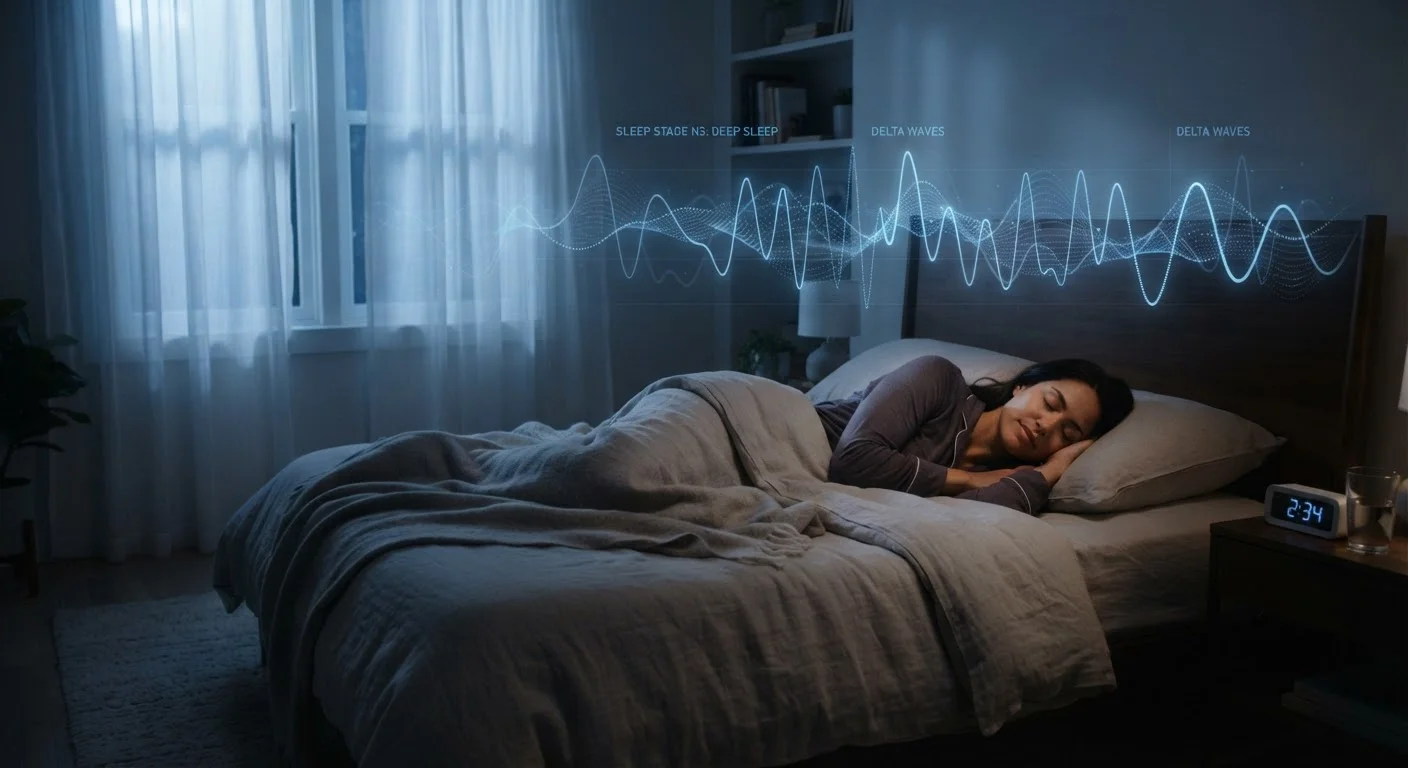
N3 is the most physically restorative stage. Slow, high-amplitude delta waves dominate brain activity. Growth hormone is released, immune function is bolstered, and cellular repair accelerates. Waking someone from N3 produces significant grogginess — a phenomenon called sleep inertia. Deep sleep is concentrated in the first half of the night, making early sleep disruptions particularly costly to physical recovery.
REM Sleep
During REM, brain activity resembles wakefulness — vivid dreaming occurs, and the eyes move rapidly beneath closed lids. The body enters a state of muscle paralysis (atonia) that prevents acting out dreams. REM is critical for emotional regulation, problem-solving, and procedural memory. Alcohol and many common sleep medications suppress REM, which partly explains why chemically induced sleep often feels less restorative.
NREM Sleep
Non-Rapid Eye Movement sleep, comprising stages N1, N2, and N3. NREM dominates the early part of the night and is essential for physical restoration and memory consolidation.
REM Sleep
Rapid Eye Movement sleep, characterized by vivid dreaming, near-waking brain activity, and muscle paralysis. It supports emotional regulation and certain types of memory.
Sleep Spindles
Brief bursts of rhythmic brain activity that occur during N2 sleep. They are associated with the consolidation of memories and the suppression of external sensory signals.
Slow-Wave Sleep
Another name for N3, the deepest NREM stage. It features slow, high-amplitude delta brain waves and is the period most linked to physical repair and immune function.
Sleep Inertia
The grogginess and impaired alertness that result from being woken during deep (N3) sleep. It can last from several minutes to over an hour depending on sleep deprivation level.
Sleep Architecture
The overall pattern and proportion of sleep stages across a night. Healthy sleep architecture reflects the right balance and sequencing of NREM and REM cycles.
Why Disrupting Any Stage Has Consequences
Each stage serves functions the others cannot fully compensate for. Losing deep sleep impairs physical recovery and immune resilience. Losing REM undermines emotional processing — research consistently links REM deprivation with increased anxiety and reduced capacity to regulate negative emotions. Even N2 disruption — common with caffeine consumed late in the day — reduces memory encoding efficiency.
Stage disruption rarely announces itself dramatically. Instead, it accumulates: difficulty concentrating, blunted mood, slower reaction time, and increased appetite (particularly for calorie-dense foods) are all documented downstream effects of fragmented or insufficient sleep architecture.
20–25%
Portion of total sleep spent in REM
In healthy adults, REM typically accounts for about 20–25% of nightly sleep, according to broadly cited sleep physiology research.
13–23%
Portion of total sleep spent in deep (N3) sleep
Deep sleep tends to decline naturally with age, dropping from higher proportions in childhood to roughly 13–23% in young adults.
Up to 2x
Increased emotional reactivity after REM loss
Studies using sleep restriction protocols have documented substantially heightened reactivity to negative stimuli following nights low in REM sleep.
Environmental factors play a large role in how well you move through these stages. Bedroom temperature, darkness, and noise levels all measurably affect how deeply and continuously the brain cycles. Similarly, light timing across the day shapes the melatonin signals that initiate and sustain sleep — explored in detail in our article on morning versus evening light and sleep quality.
If you want to build habits that actively protect your sleep architecture night after night, our complete sleep hygiene framework offers a structured, evidence-based starting point.
This article is for general informational purposes only and does not constitute medical advice. If you are experiencing significant sleep difficulties or a suspected sleep disorder, please consult a qualified healthcare professional.