

Key Takeaways
Why Sleep Hygiene Is a System, Not a Single Tip
Sleep hygiene is frequently reduced to a single piece of advice — put your phone down before bed. While screen exposure matters, treating it as the whole solution misses a larger truth: quality sleep is the output of an interconnected set of behaviors, environmental conditions, and biological signals operating across a full 24-hour cycle.
Research in sleep medicine frames sleep as a regulated physiological process driven by two systems working in concert: the circadian rhythm (your internal 24-hour clock) and sleep pressure (the gradual accumulation of adenosine, a chemical that drives the urge to sleep). Effective sleep hygiene works by supporting both systems simultaneously — not overriding one with sheer willpower.
This guide presents sleep hygiene as the framework it actually is: a set of layered habits spanning your entire day, from morning light exposure to your evening routine to the conditions inside your bedroom. For a closer look at how poor sleep habits connect to longer-term health consequences, see Sleep Hygiene: The Overlooked Pillar of Disease Prevention.
This article is for general informational purposes only and does not constitute medical advice. If you are experiencing persistent sleep difficulties, consult a qualified healthcare professional.
The Circadian Foundation: Anchoring Your Sleep Schedule
Your circadian rhythm is exquisitely time-sensitive. Irregular sleep and wake times — even by 60 to 90 minutes on weekends — can disrupt circadian alignment, a pattern sometimes called social jetlag. Studies link chronic social jetlag to poorer mood, metabolic disruption, and reduced alertness during the day.
The single most powerful circadian anchor is a consistent wake time, maintained seven days a week. This stabilizes the timing of cortisol release, body temperature rhythms, and melatonin onset — all of which feed back into how easily you fall asleep that night.
Use your wake time — not your bedtime — as your primary schedule anchor. Go to bed when you feel genuinely sleepy, but set your alarm for the same time every morning regardless of when you fell asleep.
Circadian research consistently shows that a fixed wake time stabilizes the entire sleep-wake cycle faster than attempting to regulate bedtime directly, particularly when rebuilding disrupted sleep patterns.
If you haven't fallen asleep within 20 minutes of getting into bed, get up and do something calm in dim light until you feel sleepy — then return to bed.
This practice, derived from stimulus control therapy in cognitive behavioral therapy for insomnia (CBT-I), prevents the bed from becoming mentally associated with wakefulness and anxiety, which reinforces chronic insomnia.
Morning light is the master reset switch. Getting 10–30 minutes of natural outdoor light within an hour of waking suppresses residual melatonin and sets your circadian clock forward. On overcast days, outdoor light still provides substantially more lux than indoor lighting. This single habit is among the most evidence-supported behavioral interventions in sleep science.
Evening light works in reverse: exposure to bright or blue-spectrum light after sunset delays melatonin onset. Dimming your indoor lights and using warm-toned bulbs in the two hours before bed reduces this delay without requiring complete screen abstinence.
Your Evening Wind-Down Window
Sleep onset is not a switch — it is a gradual physiological transition requiring a drop in core body temperature, a rise in melatonin, and a reduction in cognitive arousal. A structured wind-down window of 60 to 90 minutes creates the conditions for this transition to occur on schedule.
Effective wind-down practices share one feature: they reduce physiological and cognitive activation without introducing new stimulation. Evidence-supported options include:
- Progressive muscle relaxation or slow diaphragmatic breathing — both activate the parasympathetic nervous system and reduce heart rate variability in ways measurable on polysomnography.
- Reading printed material — lower cognitive demand than screens, no blue light exposure.
- A warm bath or shower 60–90 minutes before bed — the subsequent drop in skin temperature as you cool off signals the body to initiate sleep-onset mechanisms.
- Journaling or a structured worry period — offloading anxious cognition onto paper rather than into the bedroom has been shown to reduce sleep-onset latency in clinical studies.
For a deeper look at behaviorally grounded pre-sleep rituals, see Evening Rituals That Signal Your Brain It's Time to Wind Down.
Build the Routine Before You Need It
Don't wait until you're chronically sleep-deprived to establish a wind-down routine. Habituating a consistent pre-sleep sequence while your sleep is reasonably good makes it far more effective when stress or schedule disruption arrives. Think of it as building infrastructure, not fighting a fire.
Optimizing Your Sleep Environment
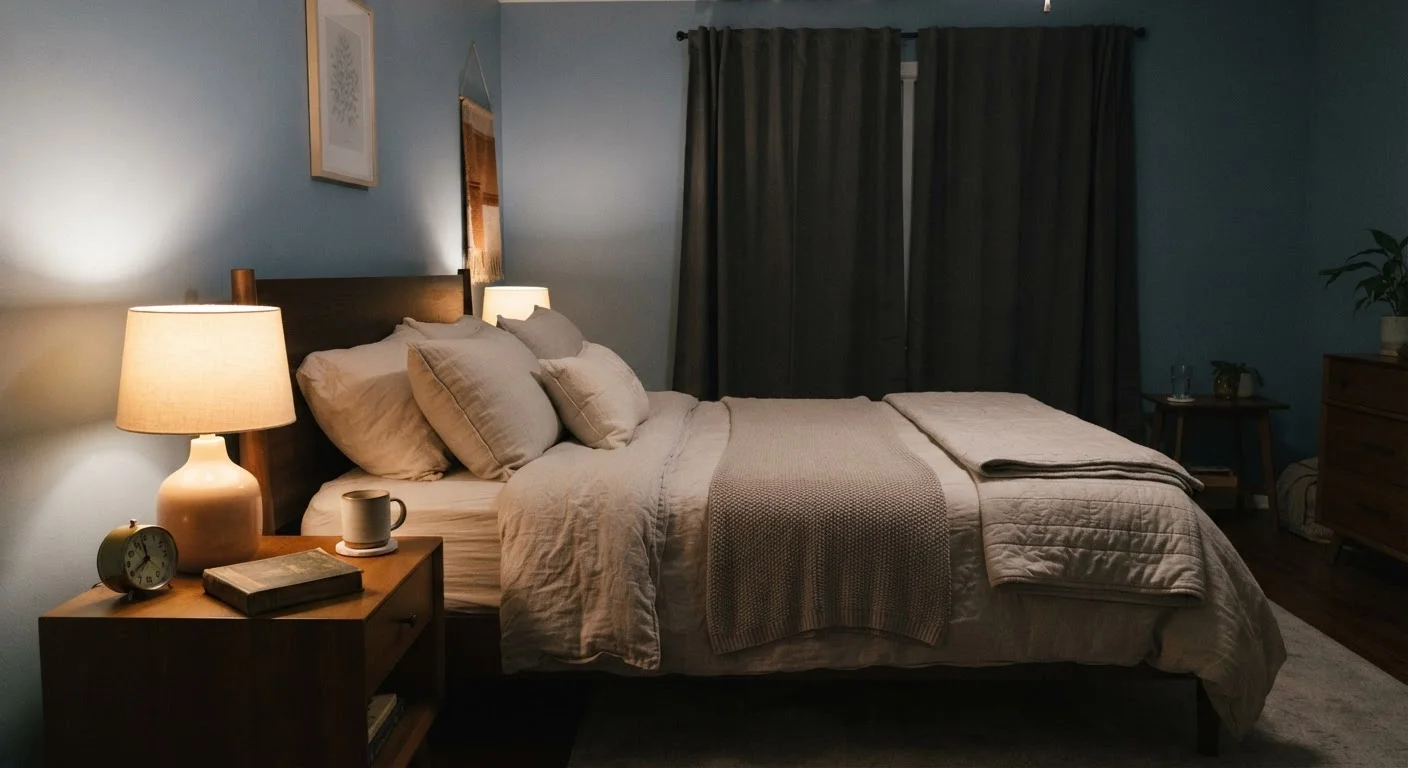
Three environmental variables have the strongest evidence base for sleep quality: temperature, light, and noise. Addressing all three costs little but yields measurable returns.
- Temperature
- Core body temperature must drop by roughly 1–2°F to initiate and maintain sleep. Most sleep researchers suggest a bedroom temperature between 65°F and 68°F (18–20°C) as a useful starting range, though individual preference varies. Breathable bedding and moisture-wicking fabrics support this thermoregulation.
- Light
- Even low-level ambient light during sleep can suppress melatonin and increase nighttime arousal. Blackout curtains or a well-fitted sleep mask are the most reliable solutions. Nightlights, if needed for safety, should use dim red or amber wavelengths, which have less circadian impact than white or blue light.
- Noise
- Intermittent noise — particularly voices and traffic — disrupts sleep architecture even when it does not fully awaken the sleeper. Consistent background sound (fans, white noise, or pink noise) can mask variable noise effectively. Earplugs remain one of the most evidence-supported and lowest-cost interventions.
For a structured self-audit of your sleep space, see Your Pre-Sleep Environment Audit.
1 in 3
U.S. adults not getting enough sleep
According to CDC surveillance data, approximately one-third of American adults regularly sleep less than the recommended minimum of seven hours per night.
~5–6 hrs
Caffeine half-life in healthy adults
Pharmacological data indicate that caffeine's half-life averages five to six hours, meaning afternoon consumption can meaningfully delay sleep onset for many people.
65–68°F
Recommended bedroom temperature range
Sleep researchers frequently cite this range (18–20°C) as supportive of the core temperature drop required for sleep onset and maintenance, though individual variation applies.
Daytime Habits That Drive Nighttime Quality
Sleep is built during the day as much as the night. Three daytime behaviors have particularly well-documented effects on sleep quality:
- Caffeine timing: Caffeine has a half-life of approximately five to six hours in healthy adults. A 2 p.m. cup leaves roughly half of its stimulant effect active at 7–8 p.m., pushing sleep onset later. Cutting off caffeine by early afternoon is a practical, evidence-grounded threshold — though individual metabolism varies.
- Physical activity: Regular moderate-intensity exercise is associated with improved sleep quality and reduced insomnia symptoms in multiple systematic reviews. Morning or afternoon timing avoids the cortisol and adrenaline spike that vigorous late-evening exercise can produce in some people.
- Nutrition timing: Large meals within two to three hours of bedtime are associated with increased sleep fragmentation and gastroesophageal reflux during sleep. Some nutrients — including tryptophan, magnesium, and certain plant compounds — are frequently discussed in relation to sleep. See Foods Frequently Associated With Better Sleep for an evidence-grounded overview of what the research does and does not support.
Morning Wake-Up: Completing the Sleep Cycle
How you wake matters nearly as much as how you fall asleep. Sleep inertia — the groggy, impaired state immediately after waking — is intensified by alarm-induced arousal from deep sleep stages, by chronic sleep debt, and by waking in a dark, warm room. It typically resolves within 15 to 30 minutes under normal conditions but can last longer when sleep debt is high.
Strategies that ease the transition from sleep to waking include:
- Bright light exposure within the first 30 minutes of waking (see the circadian section above)
- Avoiding the snooze button — fragmented light sleep after an alarm increases grogginess rather than reducing it
- Hydrating immediately after rising, since mild dehydration accumulates overnight
- A brief movement practice — even five to ten minutes of low-intensity activity accelerates arousal and cortisol normalization
A structured morning routine that accounts for sleep inertia and sets physiological conditions for the day is covered in detail in The Anatomy of an Evidence-Informed Morning Routine. Building consistency between your sleep and morning habits is where the framework becomes self-reinforcing: better nights produce more functional mornings, which — through light, activity, and schedule — feed better nights in return.
This content is for general educational purposes only. Always consult a qualified healthcare provider for guidance on personal sleep concerns or medical conditions.