

Key Takeaways
Option A
Mindfulness
The quality of attention you bring to any moment.
Best for: Anyone who wants to reduce reactivity and cultivate present-moment awareness throughout daily life.
Option B
Meditation
A structured practice for training the mind.
Best for: Those seeking a dedicated time-set exercise to build mental focus, calm, or emotional regulation.
If you want to reduce stress throughout your workday
Mindfulness
Mindfulness can be woven into everyday tasks — a brief pause before a meeting, or conscious breathing during a commute — making it accessible without carving out extra time.
If you want to build lasting focus and emotional regulation
Meditation
Regular seated meditation practice strengthens the mental skills — attention control, metacognitive awareness — that make mindfulness easier to sustain all day.
If you're completely new to either practice
Mindfulness
Starting with informal mindfulness in daily routines lowers the barrier to entry and builds familiarity with present-moment awareness before adding structured sessions.
If you want the deepest long-term mental wellness benefits
Mindfulness
Combining both practices — using meditation as formal training and mindfulness as the ongoing application — yields the most comprehensive mental wellness foundation, according to most researchers.
Why the Confusion Exists
In everyday conversation, "mindfulness" and "meditation" are used almost interchangeably — and it's understandable why. Many popular apps, books, and wellness programs blur the line, using the terms as if they describe the same thing. They don't. Understanding the distinction can help you choose the right tool for a given moment, and build a practice that actually fits your life.
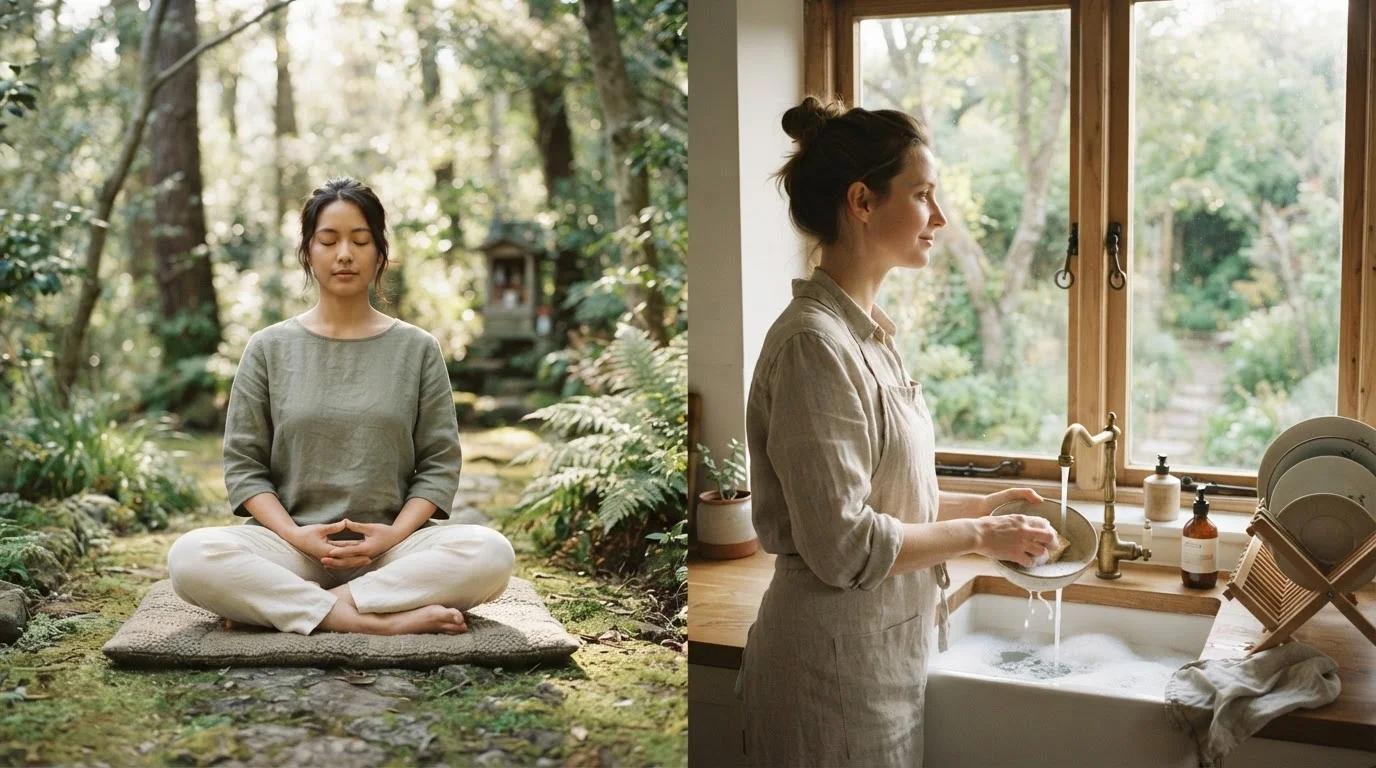
In broad terms, mindfulness is a quality of attention — an orientation toward the present moment with openness and without judgment. Meditation is a practice: a structured, intentional exercise you do for a defined period of time. Think of it this way: mindfulness is something you can be; meditation is something you do. The two overlap significantly, but they are not interchangeable. For a deeper look at what mindfulness means day-to-day, see what mindfulness actually means in everyday life.
Mindfulness: A Way of Engaging With the Present
Mindfulness, as understood in contemporary psychology and rooted in Buddhist contemplative traditions, refers to deliberately paying attention to whatever is happening right now — your thoughts, physical sensations, emotions, and environment — without immediately judging or reacting to it. Crucially, it doesn't require a cushion, a quiet room, or an app.
Mindfulness can accompany nearly any activity: noticing the texture and temperature of water while washing dishes, listening to a colleague without mentally rehearsing your reply, or pausing to observe your breathing before a difficult conversation. These informal moments of awareness are genuinely mindful, regardless of whether you've ever sat in formal meditation.
Research from institutions including Harvard Medical School and the American Psychological Association has linked regular mindfulness practice — both formal and informal — to reduced markers of stress, improved attention regulation, and greater emotional resilience. That said, individual outcomes vary considerably, and mindfulness is not a replacement for professional mental health care. For a deeper dive into building these habits into your day, explore Daily Mindfulness resources.
| Criterion | Mindfulness | Meditation |
|---|---|---|
| Definition | Quality of present-moment attention | Structured mental training technique |
| Requires dedicated time | No — woven into daily activities | Yes — set aside specific time |
| Setting | Anywhere, anytime | Usually quiet, designated space |
| Beginner accessibility | Very high — no instruction needed | Moderate — benefits from guidance |
| Primary mechanism | Sustained non-judgmental awareness | Deliberate attentional focus and training |
| Research backing | Strong across stress and attention | Strong across focus and emotional regulation |
| Best combined with | Regular meditation for deeper skill | Daily mindfulness for real-world application |
Meditation: Structured Training for the Mind
Meditation, by contrast, is a set of formal techniques practiced intentionally — typically for a defined period, with a specific mental object of focus. That focus might be the breath, a word or phrase, a visualized image, or bodily sensations. The common thread is deliberate, sustained attention.
Different meditation styles vary widely in their approach. Concentration-based practices ask you to hold a single point of focus. Mindfulness meditation — one of the most well-researched styles — trains the practitioner to observe thoughts and sensations without getting swept up in them. Mindfulness meditation and concentration meditation each play distinct roles in developing mental clarity. Practices like loving-kindness meditation, body scan, and guided visualization each carry their own benefits and suit different temperaments or goals.
Consistent meditation practice appears to train the same attentional and emotional-regulation circuits that informal mindfulness engages — which is why regular meditators often find it easier to stay mindful throughout the day. If you're exploring how to get started, Meditation Basics offers a practical foundation. You might also consider guided vs. silent meditation to understand which format suits your current stage of practice.
8 weeks
Time to measurable brain changes from meditation
A widely cited study published in Psychiatry Research found structural brain changes — including increased cortical thickness in attention-related areas — after an 8-week mindfulness-based program.
~14%
U.S. adults who meditate regularly
According to a National Center for Health Statistics survey, roughly 14% of American adults reported meditating in the previous year — up from about 4% a decade earlier.
38%
Reduction in psychological distress reported
A meta-analysis in JAMA Internal Medicine found mindfulness meditation programs associated with approximately a 38% reduction in psychological distress symptoms, though individual results varied.
How They Work Together — and When to Use Each
The most useful mental model: meditation is practice, mindfulness is application. A musician rehearses scales (practice) so that their technique becomes second nature during a performance (application). Similarly, regular meditation sessions build the mental habits — noticing when attention drifts, returning to the present without self-criticism — that make moment-to-moment mindfulness more natural.
This doesn't mean you must meditate to be mindful. Many people cultivate meaningful mindfulness through yoga, contemplative prayer, or simply slowing down during routine activities. But combining formal meditation with informal mindful awareness tends to produce more durable results over time. The related article formal meditation vs. informal mindfulness explores exactly where that boundary lies.
If time is limited, even a few minutes of deliberate breathing can act as a brief meditation that re-anchors your attention. And if you can't find a quiet moment, a mindful walk, meal, or conversation still counts. Both pathways support the same underlying goal: a steadier, more aware relationship with your own mind.
This article is for general informational and educational purposes only and is not a substitute for professional medical or mental health advice. If you are experiencing significant stress, anxiety, or other mental health concerns, please consult a qualified healthcare professional.