

Key Takeaways
Option A
Mindfulness Meditation
The open, observational approach to awareness.
Best for: Those who want to develop present-moment awareness across daily life without fixing attention to a single object.
Option B
Concentration Meditation
The focused, single-point approach to mental training.
Best for: Those who want to build deliberate attentional control and mental steadiness through sustained focus on one anchor.
If you want to reduce stress and cultivate present-moment calm in daily life
Mindfulness Meditation
Its open-monitoring approach translates directly to everyday situations, helping you respond rather than react to whatever arises.
If your mind wanders frequently and you need to build basic attentional stability first
Concentration Meditation
Repeatedly returning to a single anchor trains the mental muscle of focused attention, making it an effective foundation before opening awareness more broadly.
If you are a complete beginner unsure where to start
Concentration Meditation
A clear, defined object of focus gives beginners a simple, concrete instruction that reduces confusion during early sessions.
If you want a practice that integrates with journaling, body scans, or informal daily awareness
Mindfulness Meditation
Mindfulness pairs naturally with other reflective and somatic practices, making it easier to weave into a broader wellness routine.
If you are pursuing deeper meditative states or developing sustained focus for study or creative work
Concentration Meditation
Single-point practice is the traditional route to deepened mental absorption and is well-suited to building the kind of concentration demanding cognitive work requires.
What Each Practice Actually Is
Meditation is not one technique — it is a broad family of practices, and two of its most foundational members work quite differently. Understanding that difference matters if you want a practice that actually fits your life. For a wider frame on how these concepts relate, see Mindfulness vs. Meditation: Two Practices, Two Distinct Roles.
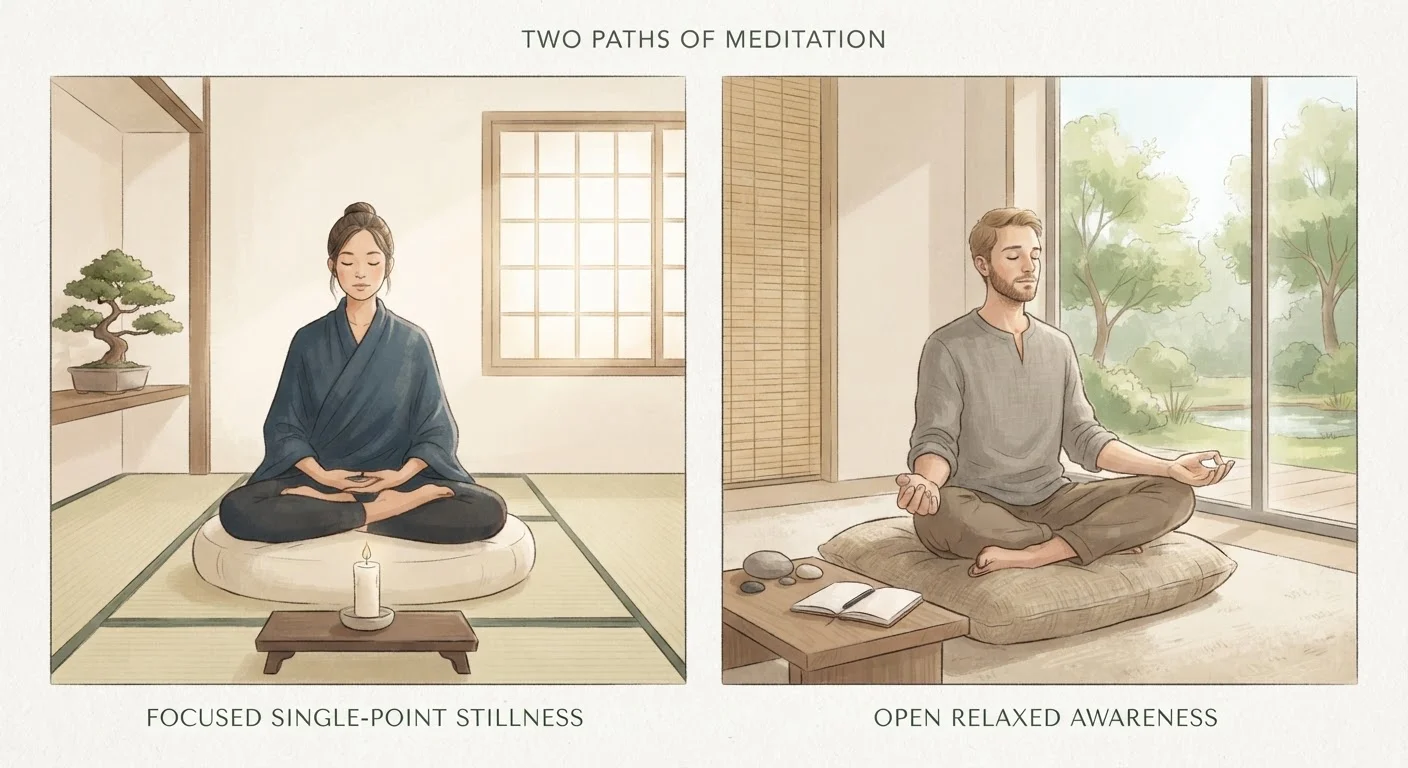
Mindfulness meditation uses what researchers sometimes call open monitoring — attention is kept broad and receptive, noticing thoughts, sensations, sounds, and emotions as they arise and pass away, without clinging or judging. The instruction is essentially: be aware of whatever is happening right now, and observe it with curiosity rather than reaction.
Concentration meditation — sometimes called focused attention practice — works in the opposite direction. You choose a single object of focus (commonly the breath, a repeated word or phrase, a candle flame, or a sound), and whenever attention drifts, you gently redirect it back. The practice is narrowing rather than broadening.
Both styles appear across numerous contemplative traditions — including Theravāda Buddhist samatha (concentration) and vipassanā (insight/mindfulness) — and have been studied extensively within modern clinical and cognitive neuroscience frameworks. To understand what mindfulness means at its most practical level, this explanation of mindfulness in everyday life is a useful starting point.
How They Train Attention Differently
The two practices are sometimes described as building different but complementary attentional skills. Research from cognitive neuroscience — including work by investigators such as Antoine Lutz and colleagues — suggests that focused-attention and open-monitoring practices show distinct patterns of neural engagement, though this field is still developing and findings should be treated as preliminary rather than definitive.
| Criterion | Mindfulness Meditation | Concentration Meditation |
|---|---|---|
| Attentional style | Open monitoring — broad awareness | Focused attention — narrow, single-point |
| Primary instruction | Notice whatever arises without judgment | Return repeatedly to one chosen anchor |
| Relationship to distraction | Distractions observed as passing events | Distractions noted, then redirected away |
| Beginner accessibility | Can feel ambiguous without prior stability | Concrete anchor makes entry straightforward |
| Daily life transfer | Translates readily to everyday awareness | Builds focus that supports demanding tasks |
| Session feel | Spacious, receptive, observational | Effortful, directed, stabilizing |
| Traditional roots | Vipassanā and similar insight traditions | Samatha and single-point focus traditions |
Concentration practice strengthens what might be called attentional stability — the ability to hold focus without being pulled away. Mindfulness practice cultivates attentional flexibility — the ability to notice what is present without getting caught in it. Many experienced practitioners and teachers suggest that concentration provides the stability needed for mindfulness to go deep, while mindfulness brings meaning and insight to concentration.
For those drawn to anchor-based practice, choosing a meditation anchor that works for you walks through breath, body, and sound as focal points.
47%
Time adults spend mind-wandering
A Harvard study by Killingsworth and Gilbert (2010) found that people's minds are wandering roughly 47% of waking hours — a baseline both practice styles aim to reduce.
8 weeks
Typical MBSR program length
Mindfulness-Based Stress Reduction (MBSR), the most studied secular mindfulness program, runs for eight weeks of structured open-awareness practice.
10–20 min
Effective daily session length for beginners
Research and clinical guidelines generally suggest sessions of 10–20 minutes are sufficient for measurable benefit when practiced consistently.
Practical Differences in a Session
In a concentration session, the instruction stays largely constant throughout: keep returning to your chosen anchor. Distraction is expected and treated neutrally — the moment of noticing you drifted and returning is, in fact, the core exercise. Sessions can feel effortful, especially early on, but that effort is the training.
In a mindfulness session, the field of awareness stays open. You are not trying to prevent thoughts from arising — you are watching them arise and pass. The posture of the mind is receptive rather than directive. This can feel more spacious, but it can also feel vague or unsettled for practitioners who have not yet built basic attentional stability.
Both styles generally benefit from a consistent posture — seated comfortably with the spine supported, either on a chair or cushion — and a quiet, predictable environment when starting out. Guided vs. silent meditation is another structural choice that interacts with both styles, and worth considering as you establish a routine.
This article is for informational purposes only and does not constitute medical or psychological advice. If you have a mental health condition or are managing chronic stress, consult a qualified healthcare professional before beginning a new meditation practice.
Choosing a Starting Point — and Combining Both
If you are new to meditation, concentration practice often provides a clearer first instruction: pick your breath, return when you wander. That simplicity lowers the barrier significantly. Once some attentional stability is in place, opening the practice toward mindfulness becomes easier and more rewarding.
If you are already comfortable sitting and want to extend awareness into daily life — noticing how you react during difficult conversations, or pausing before responding to stress — mindfulness-based approaches tend to translate more directly. See structured vs. spontaneous mindfulness for how to adapt that awareness beyond formal sessions.
Many practitioners and teachers treat the two styles as sequential or complementary rather than competing. A session might begin with five minutes of breath-focused concentration to settle the mind, then open into broader mindful awareness. This flexible sequencing is well-established in both traditional and contemporary secular meditation programs.
Whichever approach you start with, consistency matters more than duration. Regular brief sessions — even ten minutes daily — tend to produce more durable benefits than occasional longer sits. For a comprehensive grounding in how meditation works and how to sustain it, Meditation from the Ground Up covers the science and practical foundations in depth.