

Key Takeaways
Why Movement Is a Legitimate Mindfulness Practice
Many people assume mindfulness requires sitting quietly with closed eyes. In reality, mindfulness is a quality of attention, not a posture. What matters is the deliberate orientation of awareness toward present-moment experience — and the body in motion provides a rich, continuously changing stream of sensory information to attend to.
Formal walking meditation has roots in multiple contemplative traditions and has been studied in contemporary clinical contexts as an accessible entry point for people who find seated practice difficult. Research suggests that mind-body movement practices — including walking meditation and mindful stretching — may support attention regulation and stress reduction, though individual results vary and this remains an active area of investigation.
Movement-based practice also has a practical advantage: it fits inside the day without requiring extra time. The walk to the parking lot, a stretch between meetings, or the climb up three flights of stairs can all become genuine practice moments. For a broader look at how formal and informal practice compare, see Formal vs. Informal Mindfulness Practice: Which Fits Your Life.
This Is General Wellness Information
The techniques described here are general mindfulness education, not medical or therapeutic advice. If you experience pain, dizziness, anxiety, or other symptoms during movement or breathwork, stop and consult a qualified healthcare professional before continuing.
What You'll Need Before You Begin
Mindful walking requires almost no equipment, but a few simple conditions make practice easier, especially early on.
What you will need
Timer or Clock
Sets a clear session boundary so attention stays on movement rather than tracking elapsed time.
Comfortable, Supportive Footwear
Provides safe, stable foot contact that makes sensing ground texture and pressure easier.
Journal or Notes App
Useful for jotting post-session observations about what the mind did during movement practice.
If sitting practice is your primary frame of reference, Sitting Still Isn't the Only Option offers helpful context for broadening that frame before you start.
Step-by-Step: How to Practice Mindful Walking and Movement
Follow these steps sequentially for a standalone session. With practice, you will find the sequence becomes internalized and can be applied spontaneously to any movement in your day.
Choose Your Movement Context
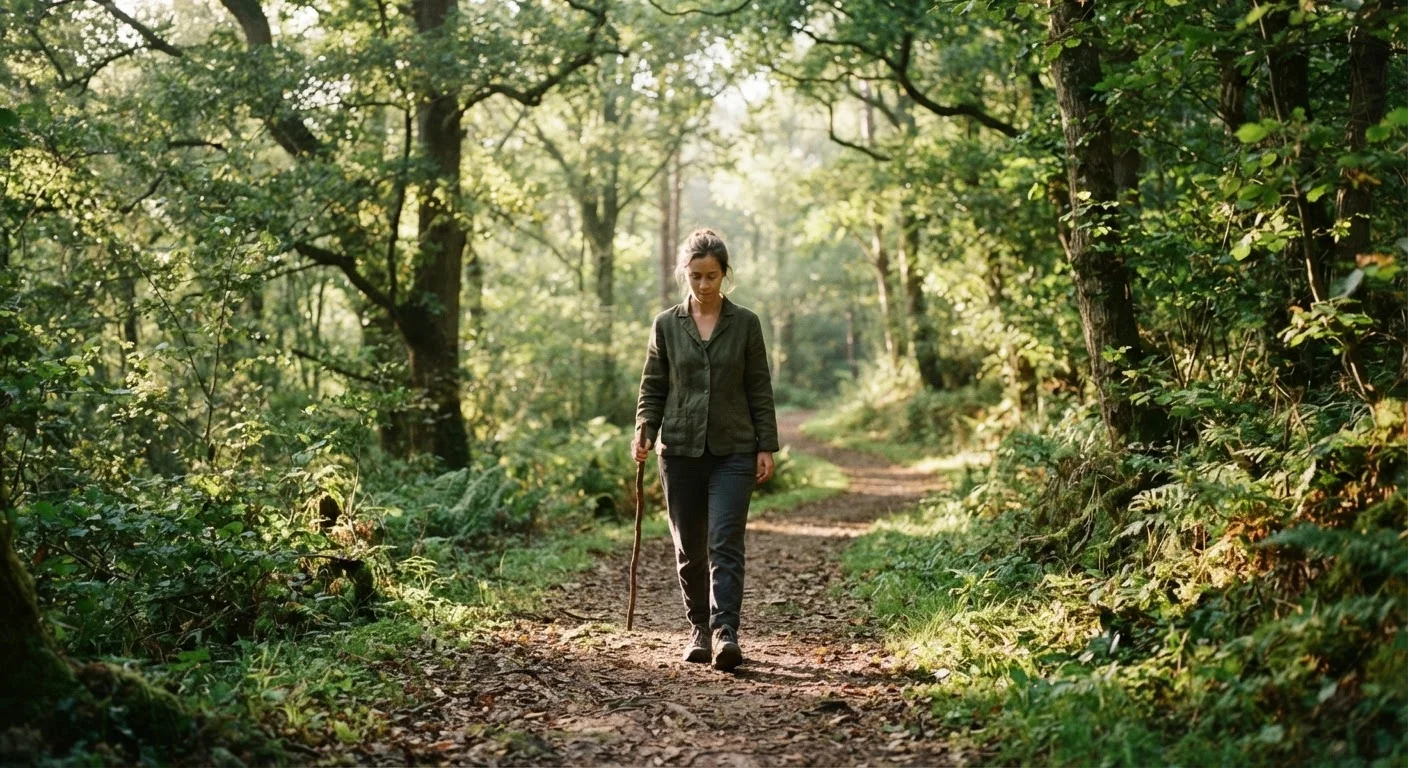
Decide whether you will practice formal mindful walking — a dedicated slow walk with no destination — or informal mindfulness embedded in a task you are already doing, such as walking to the kitchen, climbing stairs, or stretching in the morning. Both are legitimate. Formal practice builds the skill faster; informal practice makes it stick across the day.
If this is your first attempt, choose a short indoor corridor or a quiet outdoor path with minimal traffic and distractions.
Set a Clear Intention and Time Limit
Before moving, pause and silently state your intention: For the next [5–10] minutes, I will bring full attention to the experience of moving. Set a timer so you are not pulled into clock-watching. This boundary converts an ordinary walk into a defined practice window.
Begin Moving at Half Your Normal Pace
Slow movement makes sensory detail perceptible. Start walking at roughly half your habitual speed. Notice immediately how unfamiliar this feels — that unfamiliarity is itself an anchor, signaling to the nervous system that something different is happening.
Keep your gaze softly downward and forward, eyes open, to maintain spatial awareness.
Anchor Attention to Physical Sensation
Direct awareness to the sequence of sensations in each step: the heel making contact, the rolling through the arch, the lift of the toe, the brief suspension, and the landing again. You may silently label these phases — heel, roll, lift, swing, land — to keep attention anchored. Notice temperature, texture through the sole, and any subtle shifts in balance.
This sensory anchoring is similar to using breath as an object in seated meditation, except the object is now the body in motion. For comparison with other sensory techniques, see Sensory Anchors: Using Touch, Sound, and Breath to Return to Now.
Notice When the Mind Wanders and Return Gently
The mind will drift — to a task list, a conversation, or a random memory. This is completely normal and is not failure. The moment you notice the drift, acknowledge it without judgment (thinking or planning is sufficient), and redirect attention back to the felt sense of movement. Each return is the core repetition of this practice, equivalent to a bicep curl in strength training.
Expand to Breath and Environment
Once the movement anchor feels stable, allow breath to enter awareness alongside it. Notice whether walking pace naturally coordinates with your breathing rhythm. Then, without losing the body anchor, briefly open attention to environmental detail: the quality of light, a distant sound, the feeling of air moving. This panoramic awareness — body plus environment — reflects what mindfulness researchers sometimes call open monitoring, as opposed to focused attention on a single object.
Close the Session With a Brief Pause
When the timer sounds, stop walking and stand still for 30 seconds. Notice the contrast: the body is now stationary, but sensation continues — heartbeat, breath, residual warmth in the feet. This closing pause helps consolidate the transition between deliberate practice and ordinary activity, rather than snapping abruptly back to autopilot.
Start With Just One Minute
If a full mindful-walking session feels ambitious, begin with a single mindful minute — for example, the walk from your car to your front door. Brief, repeated exposures build the habit more reliably than occasional long sessions. Consistency matters more than duration.
Outdoor Walking: Stay Aware of Surroundings
Practicing mindful attention during outdoor walks is valuable, but never allow inward focus to override situational awareness. Keep eyes open, stay alert to traffic and uneven terrain, and avoid headphones at high volume. Safety always takes precedence over depth of practice.
Applying This Practice Beyond Dedicated Sessions
The real value of mindful movement emerges when isolated sessions begin influencing the rest of the day. Start by designating one recurring daily movement as a consistent anchor — the same walk, the same staircase, the same morning stretch. Repetition in a fixed context accelerates habit formation.
From there, everyday moments become practice opportunities: washing dishes, folding laundry, even the transition between rooms. This integration mirrors what researchers and clinicians describe as informal mindfulness practice — presence threaded through ordinary activity rather than confined to a designated session.
To honestly assess where mindful attention is and isn't showing up across your day, a structured mindfulness habit audit can be a useful next step. And if you are curious how movement-based awareness complements other sensory practices, mindful eating applies a very similar attentional approach at the table.
This article is for general informational and educational purposes only and does not constitute medical advice. If you have a health condition, chronic pain, balance concerns, or any symptoms affecting your movement, consult a qualified healthcare professional before beginning any new physical or mindfulness practice.