

Key Takeaways
Why Movement Can Be a Meditation Anchor
Most people picture meditation as sitting cross-legged in silence. That image, while valid, leaves out a wide range of practices that use movement as the primary anchor for attention. For people who experience restlessness, chronic pain, anxiety, or simply don't have a quiet corner at home, seated stillness can feel like a barrier rather than a gateway.
Movement-based meditation works on the same fundamental principle as any other form: you choose an object of attention — breath, bodily sensation, the rhythm of your steps — and you return to it whenever the mind wanders. The posture is a vehicle, not the destination. Research on practices like mindful walking and yoga-based meditation suggests measurable benefits for stress, mood, and cognitive focus, though individual results vary and much of the field is still developing. For a broader grounding in how meditation works in general, see our foundational guide to meditation.
Below are five well-established movement-based approaches, each offering a distinct entry point into meditative awareness.
Walking Meditation
Walking meditation is perhaps the most accessible entry point into movement-based practice. Rather than walking to get somewhere, the goal is to walk in order to be somewhere — fully present with each step.
Choose a short path of 10–20 feet indoors, or a quiet outdoor stretch. Walk at a noticeably slower pace than usual. Direct your attention to the physical sensations of lifting, moving, and placing each foot. Notice the shift of weight, the contact of the sole with the ground, and the subtle muscular engagement in your legs. When your mind wanders to thoughts or planning, gently redirect attention back to the sensation of walking.
Research published in mindfulness and psychology journals has linked mindful walking to reduced rumination and improved mood, though study sizes vary. Even brief sessions — as short as 10 minutes — may support a sense of calm and grounded awareness.
Walking meditation transforms a routine activity into a powerful anchor for present-moment awareness.
Tai Chi and Qigong
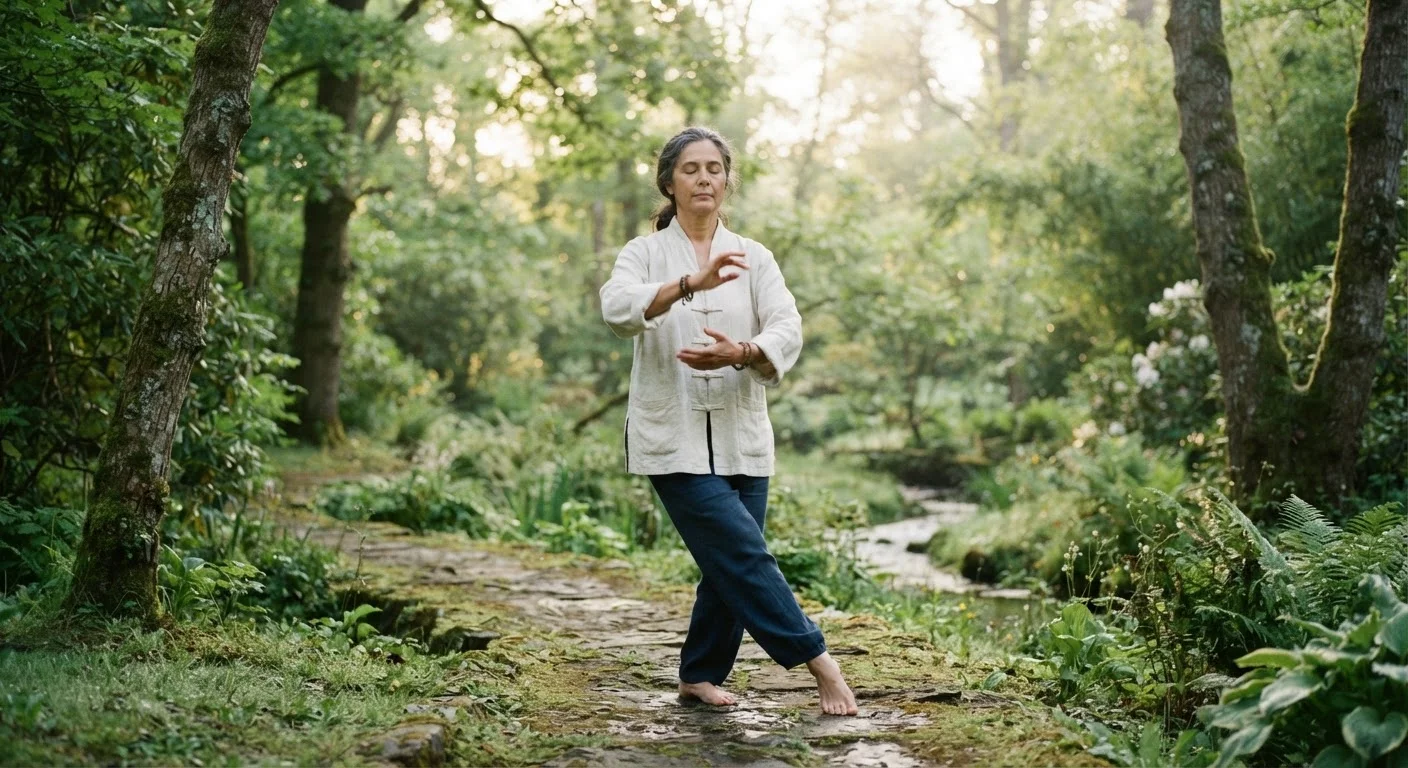
Tai chi and qigong (pronounced chee-gung) are traditional Chinese movement practices that pair slow, deliberate physical sequences with intentional breathing and focused attention. Both are considered mind-body disciplines — meaning the mental and physical elements are inseparable parts of the practice.
Movements in tai chi follow set forms — choreographed sequences learned progressively. Qigong tends to be simpler and more repetitive, making it easier for beginners. In both cases, the practitioner coordinates breath with movement and directs awareness to the body's internal sensations rather than external goals.
A substantial body of research — including several systematic reviews — suggests these practices may support balance, reduce perceived stress, and benefit cardiovascular health in older adults. They are generally low-impact and can often be adapted for people with limited mobility, though individual guidance from an instructor is valuable when starting out.
Tai chi pairs deliberate movement with breath, making the whole sequence a sustained act of attention.
Mindful Yoga
Yoga is widely practised for flexibility and physical fitness, but its traditional roots are explicitly meditative. When practised mindfully, yoga postures (asanas) become an opportunity to observe bodily sensation, breath, and mental reactions without judgment.
The key distinction between a workout-oriented yoga class and a meditative one is where your attention goes. In mindful yoga, you're not performing shapes for external approval — you're noticing what each posture feels like from the inside: where tension lives, how breath changes, what thoughts arise. This inward orientation is the meditative ingredient.
Styles like yin yoga, restorative yoga, and slower hatha classes are particularly well-suited to this approach. Even a short sequence of five or six poses, practised slowly and with attention, can serve as a complete meditation session. If you already have a sitting practice, consider reading about integrating breathwork to deepen the breath-awareness layer of your yoga sessions.
Mindful yoga shifts the goal from performing postures to observing sensation, breath, and mental reaction.
Body-Scan Movement
A body scan is traditionally done lying still, but the same principle — systematically directing attention through different areas of the body — can be applied during gentle movement. This hybrid approach suits people who find lying still frustrating or who tend to fall asleep during passive practices.
Begin standing or seated. As you make slow, deliberate movements — rolling the shoulders, rotating the neck gently, shifting weight side to side — pause your attention at each body region for several breath cycles. Notice temperature, tension, ease, or neutrality without trying to change anything. Then move on to the next area.
This practice builds interoceptive awareness — the ability to sense the body's internal state — which some researchers associate with improved emotional regulation. It requires no equipment and can be done in a small space within minutes.
Pairing body-scan attention with slow movement develops interoceptive awareness without requiring stillness.
Mindful Stretching and Everyday Movement
You don't need a formal practice to experience movement-based meditation. Any repetitive, low-demand physical activity — gentle stretching, washing dishes, folding laundry, or a slow garden walk — can become meditative when approached with deliberate attention.
The method is straightforward: choose one activity and commit to doing it with your full senses engaged. Notice the physical sensations, sounds, textures, and rhythms involved. When your mind drifts to your to-do list or a replayed conversation, gently bring it back to the activity at hand. This is sometimes called informal mindfulness practice.
Informal practice is particularly valuable for people with limited time or unpredictable schedules. It integrates awareness into life as it already exists rather than requiring a separate block of time. For a deeper look at how informal practice compares with structured sitting, see formal vs. informal mindfulness practice. And for ideas on low-impact movement that supports an active lifestyle without requiring a gym, our low-impact movement guide offers practical options.
Any repetitive physical task becomes meditative when you engage your full senses and return attention gently when it wanders.
Choosing the Right Practice for Your Life
None of these practices requires special equipment, a studio membership, or prior experience. Start with whichever feels most natural given your current fitness level, daily schedule, and temperament. Even five intentional minutes of mindful walking or a single slow round of body-scan movement counts as practice — consistency matters more than duration.
Start With Just One Practice
Trying several approaches at once can dilute focus and make it harder to build consistency. Pick a single movement-based practice that genuinely appeals to you and commit to it for two to three weeks before experimenting with others. Even brief, regular sessions tend to produce more lasting benefit than occasional longer efforts.
If you're curious how movement-based practice compares to sitting meditation or informal everyday awareness, our article on formal vs. informal mindfulness explores both paths in depth. You might also explore mindfulness in motion for practical techniques to bring awareness into walking and everyday physical tasks.
This article is for general informational and educational purposes only and does not constitute medical advice. If you have an existing health condition, injury, or mental health concern, please consult a qualified healthcare professional before beginning any new movement or meditation practice.