

Key Takeaways
Why Nutrition Labels Exist and What They Cover
The Nutrition Facts label is a federally standardized panel required on most packaged foods sold in the United States. Overseen by the Food and Drug Administration (FDA), the label underwent a significant redesign — fully phased in by 2021 — to reflect updated nutrition science and real-world eating patterns. Its purpose is straightforward: give consumers consistent, verifiable information about what they're eating.
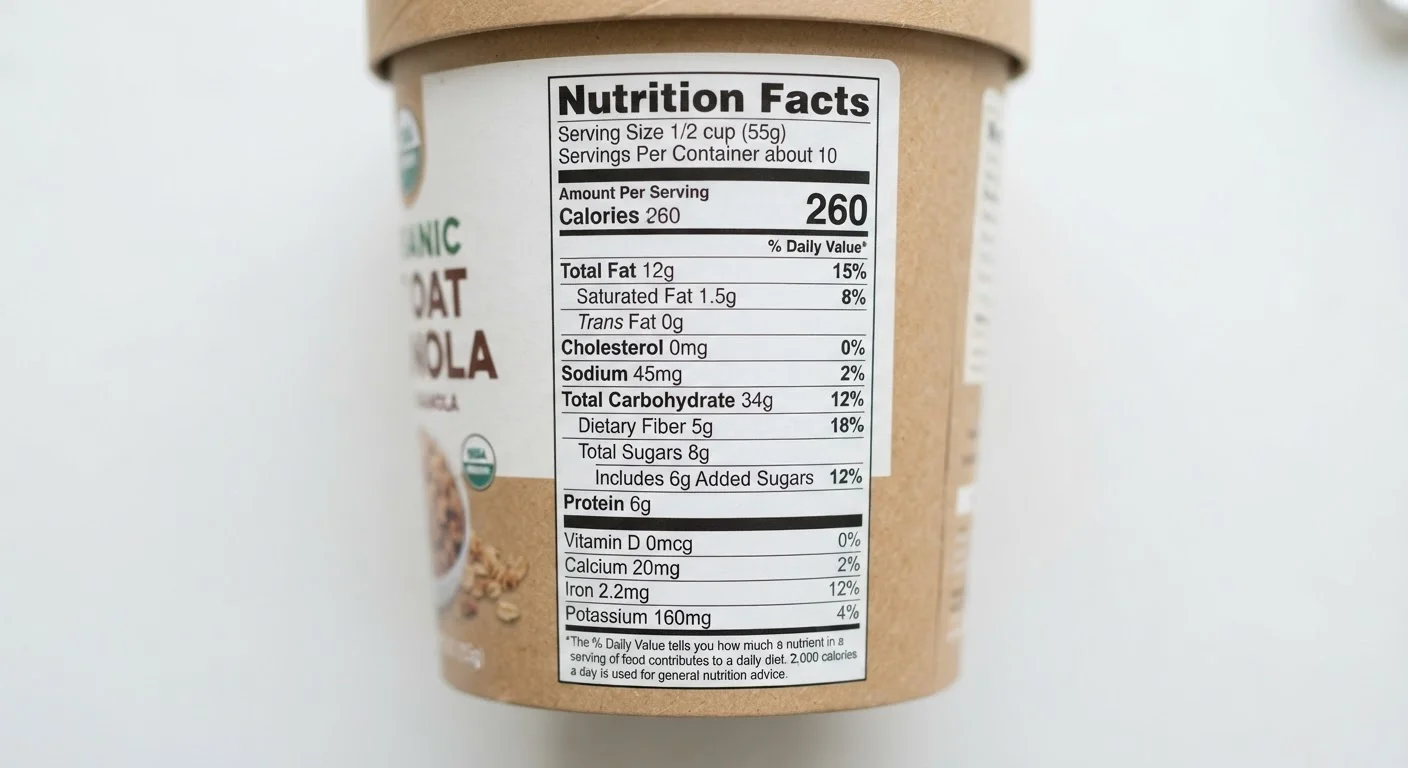
Every label covers six core areas: serving size, calories, macronutrients (fat, carbohydrates, and protein), select micronutrients, percent daily values, and the ingredient list. Understanding how these sections relate to one another is what transforms the label from a confusing grid of numbers into a genuinely useful tool. For a deeper look at vitamins and minerals listed on labels, see our plain-language guide to vitamins and minerals.
What you will need
Step-by-Step: How to Read Each Section
Work through the label from top to bottom. Each section builds on the one above it, so reading out of order often leads to misinterpretation — particularly with calories and macronutrient totals.
Start with serving size
The serving size appears at the very top of the label and anchors every number that follows. It reflects the amount the FDA considers a standard reference portion — not necessarily a recommended amount to eat. If a bag of chips lists a serving size as 1 oz (about 28 g) and you eat 2 oz, every value on the label doubles. Always establish how many servings you're actually consuming before reading any other figure.
Assess the calorie count in context
Calories measure the energy a food provides per serving. As a general reference, the FDA bases its %DV calculations on a 2,000-calorie daily diet — though individual caloric needs vary based on age, sex, activity level, and health status. Rather than judging a food solely by its calorie number, use it alongside the macronutrient breakdown to understand where those calories are coming from.
Review the macronutrient breakdown
The label lists three macronutrients: total fat, total carbohydrate, and protein. Each is broken down further:
- Fat is divided into saturated fat and trans fat. Unsaturated fats (mono- and polyunsaturated) are sometimes listed but not always required.
- Carbohydrates are broken into dietary fiber, total sugars, and — importantly — added sugars, which was a key addition in the 2021 label update.
- Protein is listed as a total with no required breakdown by type.
Pay particular attention to added sugars and saturated fat, as dietary guidance from organizations such as the American Heart Association consistently identifies these as nutrients to limit for general cardiovascular health.
Check the micronutrient section
Below the macronutrients, the label lists four required micronutrients: Vitamin D, Calcium, Iron, and Potassium. These were selected because research indicates Americans commonly fall short of adequate intake. Manufacturers may voluntarily list additional vitamins and minerals. Values are shown as %DV, making it easy to spot whether a food is a meaningful source of a given nutrient.
Use %DV as your quick reference
Percent Daily Value (%DV) tells you how much a nutrient in one serving contributes toward a general daily reference intake. The FDA's rule of thumb: 5% DV or less is considered low; 20% DV or more is considered high. This scale works in both directions — you generally want nutrients like fiber, calcium, and iron to be high, while sodium, saturated fat, and added sugars ideally stay low.
Read the ingredient list
The ingredient list appears below the Nutrition Facts panel and is ordered by weight — the ingredient present in the greatest amount by weight is listed first. A short list is not automatically better, and a long list is not automatically worse, but the list reveals what the Nutrition Facts panel cannot: what the food is actually made of. Look for the position of added sugars (they appear under many names, including corn syrup, dextrose, and cane juice) and whether whole foods or refined ingredients lead the list.
Compare Labels on Equal Footing
When comparing two products, confirm that serving sizes are the same before drawing conclusions. A cereal with 150 calories per 30g serving is not directly comparable to one listed at 200 calories per 55g serving without adjusting for the difference. Standardizing by weight or volume makes comparisons meaningful.
Common Label Claims and What They Actually Mean
Front-of-package claims like "low fat," "reduced sodium," or "good source of fiber" are regulated by the FDA and have specific legal definitions. Low fat means 3 grams or fewer per serving. Good source means 10–19% DV per serving. High in or excellent source means 20% DV or more. These terms describe a single nutrient — they say nothing about the product's overall nutritional profile.
The word natural on food packaging, like on beauty products, carries less regulatory weight than many consumers assume. It does not mean organic, minimally processed, or free of additives. Always cross-check front-of-label claims against the Nutrition Facts panel and ingredient list before drawing conclusions. Understanding how to think about what a balanced plate actually looks like can help you put individual label numbers into meaningful context.
Front-of-Package Claims Can Mislead
A product labeled "low fat" may compensate with higher sugar content to maintain flavor. "Reduced sodium" only means less sodium than the original version of the same product — it may still be high overall. Always read the full Nutrition Facts panel rather than relying on front-of-package marketing language.
Putting the Label to Practical Use
The most actionable use of a nutrition label is comparison: holding two similar products side by side and evaluating them on the nutrients that matter most for your eating goals. When reviewing labels in a grocery context, look first at serving size (to ensure you're comparing equivalent amounts), then at sodium, added sugars, and fiber — three nutrients with outsized influence on long-term health outcomes.
Labels are also useful for building portion awareness without fixating on calorie totals alone. Knowing that a "single serving" of granola is a quarter cup — far less than most people pour — is the kind of grounding information that supports realistic, sustainable choices.
This article is for general informational purposes only and does not constitute medical or dietary advice. If you have specific health conditions or nutritional needs, consult a registered dietitian or qualified healthcare professional.