

Key Takeaways
Our Verdict
Calorie counting offers measurable precision that benefits those with specific clinical or performance goals, but it carries real barriers to long-term adherence. Portion awareness is a more flexible, psychologically sustainable approach that suits most everyday adults seeking balanced eating. Neither method is universally superior — the most effective strategy is the one you can maintain consistently.
| Best for | Recommended |
|---|---|
| Those seeking a flexible, intuitive everyday eating habit | Portion Awareness |
| Those with specific clinical nutrition or performance goals | Calorie Counting |
| Those prone to food-related stress or obsessive tracking behaviors | Portion Awareness |
| Those who enjoy data-driven self-monitoring and have time to track | Calorie Counting |
Two Approaches, One Goal
Most conversations about managing food intake eventually arrive at one of two camps: calorie counting or portion awareness. Both aim to help people eat in a way that supports their health, but they operate very differently in practice. Understanding what each approach actually involves — and where each tends to fall short — helps clarify which strategy is more likely to work for you over time.
Calorie counting involves tracking the specific energy content of everything you eat, typically through apps or food labels. Portion awareness, by contrast, focuses on the relative size of what you eat — using visual cues, plate composition, and hunger signals rather than numbers. These are not mutually exclusive, but for most people, they represent meaningfully different relationships with food.
For background on navigating food labels in either approach, see our guide to reading nutrition labels.
The Case for Calorie Counting
Tracking calories offers a level of precision that can be genuinely useful in specific contexts. Research consistently shows that awareness of energy intake supports weight management when applied accurately. For people with clinical nutrition goals — such as those working with a registered dietitian on a medically supervised plan — numerical tracking can provide meaningful accountability.
Calorie counting also removes ambiguity. When every gram is logged, there is less room for unconscious underestimation, which studies suggest is common even among health-focused eaters. For those who find structure motivating and enjoy data, tracking can feel empowering rather than restrictive.
However, the practical limitations are significant. Calorie data on labels carries a legal margin of error of up to 20% in the US, meaning logged totals may not reflect reality. Tracking every meal requires sustained time, attention, and access to accurate nutritional information — conditions that are difficult to maintain across diverse social settings, travel, or busy schedules.
| Calorie Counting | Portion Awareness | |
|---|---|---|
| Precision | High (numerical targets) | Moderate (visual estimates) |
| Ease of use daily | Requires tools and time | No tools needed |
| Flexibility in social settings | Difficult without data access | Adaptable anywhere |
| Psychological burden | Can increase food anxiety | Generally lower stress |
| Learning curve | Low initially, tedious over time | Higher initially, easier long-term |
| Best suited for | Clinical or performance goals | Everyday sustainable habits |
The Case for Portion Awareness
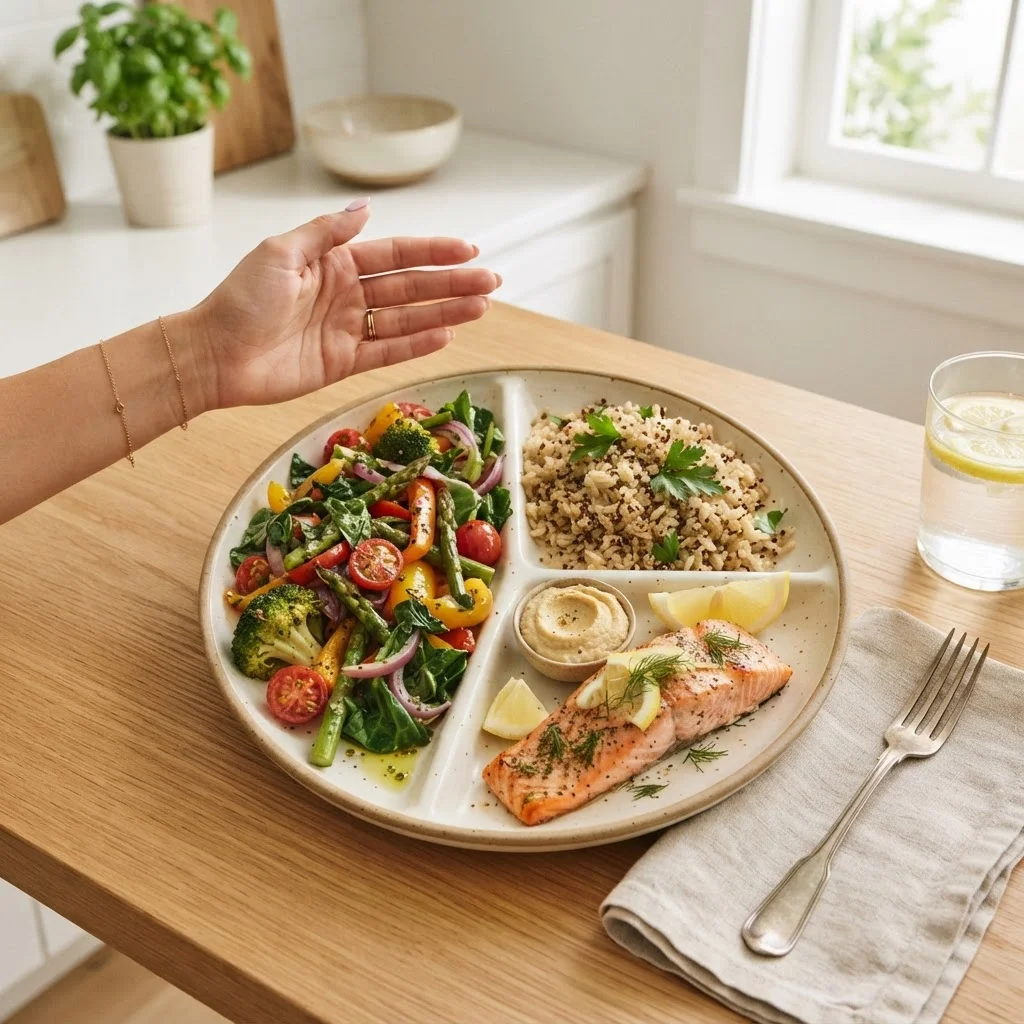
Portion awareness shifts the question from "how many calories?" to "how much of what?" Rather than assigning numbers to food, it relies on visual proportion, plate composition, and attention to hunger and fullness cues. Common frameworks — like filling half a plate with vegetables, a quarter with lean protein, and a quarter with whole grains — give structure without requiring any tools.
This approach aligns with principles explored in mindful eating, which emphasizes tuning into your body's signals rather than external metrics. Research suggests that eating attentiveness — paying attention to what and how much you consume — is associated with better appetite regulation over time.
Portion awareness is also more adaptable. It travels to restaurants, social events, and unfamiliar kitchens without requiring an app or scale. For people who have experienced stress or anxiety around food tracking, it can offer a healthier path forward. That said, it does require developing reliable judgment over time, and early on, portion sizes can be misjudged — especially for calorie-dense foods like nuts, oils, or cheeses.
Use Your Hand as a Portion Guide
A simple and portable portion tool is your own hand. A palm-sized serving works well for protein, a cupped hand for carbohydrates, a thumb for fats like oils or nut butters, and a fist for vegetables. These proportions naturally scale with body size, making them more personalized than fixed measurements. With practice, these visual references become second nature.
Choosing What Works for You
The "best" approach is the one you can sustain without it undermining your overall relationship with food. If tracking causes anxiety, rigidity, or preoccupation with numbers, those are signals worth taking seriously — observable signs that an eating pattern isn't working are worth understanding before committing to any method.
Similarly, if portion-based eating feels too vague and you find yourself consistently overeating without clear guidance, a more structured approach — even temporarily — may help calibrate your intuition. Many people find a hybrid useful: using calorie information occasionally as a reference point while relying primarily on portion-based habits day to day.
It's also worth recognizing that food quality, meal timing, stress, sleep, and emotional context all shape how your body responds to what you eat. No single tracking method accounts for all of these factors. For anyone with a history of disordered eating, specific health conditions, or questions about what approach fits their individual circumstances, consulting a registered dietitian is the most appropriate step.
This article is for general informational purposes only and does not constitute medical or nutritional advice. Always consult a qualified healthcare professional before making significant changes to your diet.