

Key Takeaways
Our Verdict
Neither mineral nor chemical sunscreen is universally superior — effectiveness depends on consistent use, correct application, and how well a formula suits your skin. Mineral sunscreens offer a lower-irritation profile and are often recommended for sensitive or compromised skin barriers, while chemical formulas excel in wearability and cosmetic elegance for daily use on resilient skin.
| Best for | Recommended |
|---|---|
| Sensitive, reactive, or rosacea-prone skin | Mineral sunscreen |
| Darker skin tones seeking no white cast | Chemical sunscreen |
| Children or those prioritizing low-toxin routines | Mineral sunscreen |
| Daily wear under makeup or in humid climates | Chemical sunscreen |
How Each Type Works
The core difference between mineral and chemical sunscreens lies in their mechanism of action — and understanding it helps cut through a lot of marketing confusion.
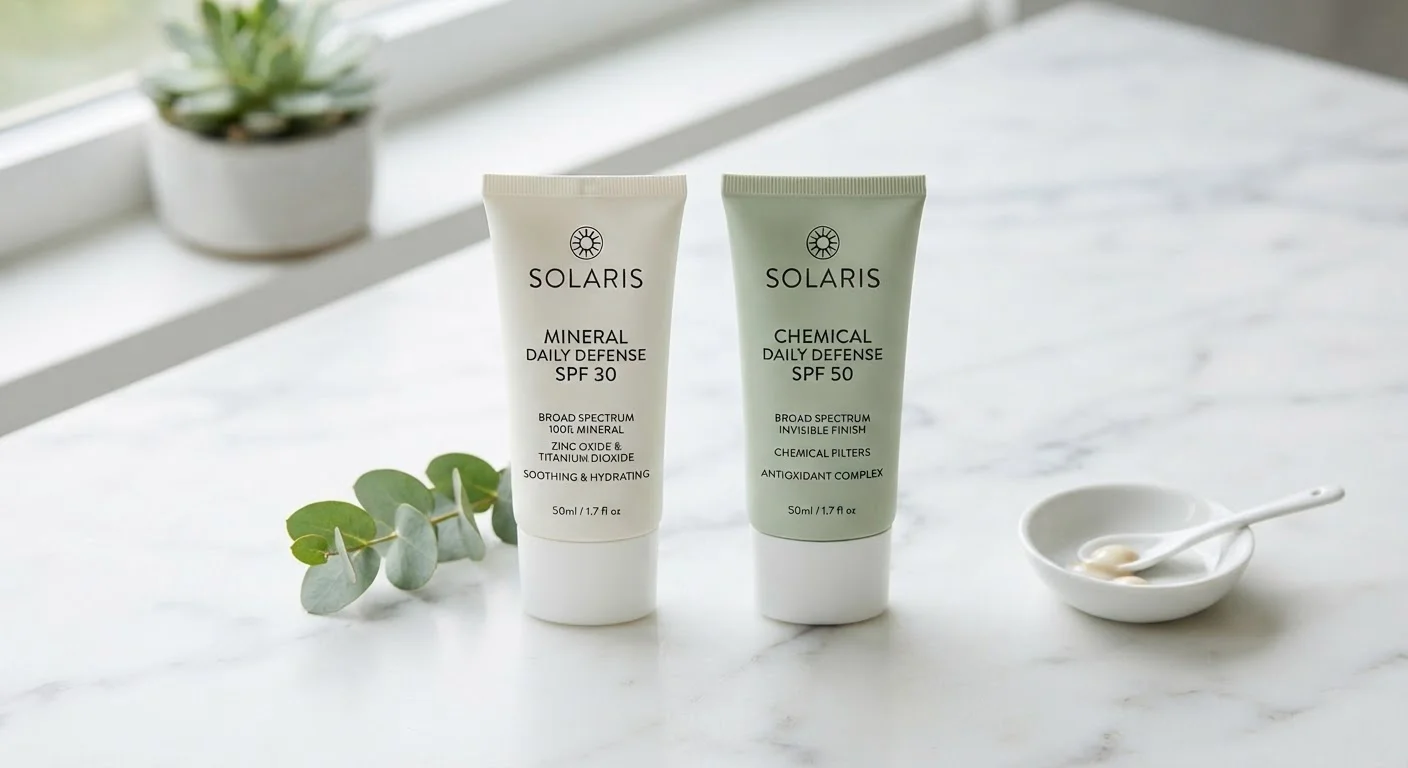
Mineral sunscreens (also called physical sunscreens) use inorganic compounds — primarily zinc oxide, titanium dioxide, or both — as their active ingredients. These particles sit on top of the skin and work by scattering and reflecting UV radiation before it penetrates the skin's surface. They provide broad-spectrum protection, meaning they guard against both UVA (aging) and UVB (burning) rays.
Chemical sunscreens rely on organic (carbon-based) compounds such as avobenzone, oxybenzone, octinoxate, or octisalate. Rather than reflecting UV rays, these ingredients absorb UV energy and undergo a photochemical reaction that converts that energy into a small amount of heat, which is then released from the skin. Different chemical filters cover different parts of the UV spectrum, which is why many chemical sunscreens combine multiple active ingredients to achieve broad-spectrum coverage.
For a deeper look at the skin-level interactions of each approach, see how chemical and physical sunscreens protect skin differently.
| Mineral Sunscreen | Chemical Sunscreen | |
|---|---|---|
| Active ingredients | Zinc oxide, titanium dioxide | Avobenzone, oxybenzone, octinoxate, others |
| Mechanism | Reflects and scatters UV rays | Absorbs and converts UV energy to heat |
| Onset of protection | Immediate upon application | 15–20 minutes after application |
| Skin sensitivity | Generally low irritation risk | May irritate sensitive or reactive skin |
| Cosmetic finish | Can leave white cast | Blends invisibly, lighter texture |
| Photostability | Stable under UV exposure | Some filters degrade without stabilizers |
| FDA safety designation | GRASE (zinc oxide, titanium dioxide) | More data needed for several filters |
| Environmental concern | Generally considered reef-safer | Some filters linked to coral reef damage |
Skin Compatibility and Tolerability
For many people, the choice between mineral and chemical sunscreen comes down to how their skin responds to each formula.
Mineral sunscreens are widely considered the gentler option. Because their active ingredients remain on the skin's surface rather than being absorbed, they're less likely to trigger irritation, stinging, or allergic reactions. Dermatologists frequently recommend mineral formulas for individuals with sensitive skin, rosacea, eczema, or a compromised skin barrier. They are also commonly used on children, though anyone with specific health concerns should consult a healthcare provider before selecting a sunscreen formulation.
One notable trade-off is the white cast. Zinc oxide and titanium dioxide particles are opaque, and traditional mineral sunscreens can leave a visible white or grayish residue — a particular concern for people with medium-to-deep skin tones. Newer micronized and nano-formulated versions reduce this effect, though the research on the systemic safety of nano-particles is still evolving.
Chemical sunscreens tend to blend invisibly and feel lighter on skin, which improves daily wear compliance. However, some chemical filters — oxybenzone in particular — have been associated with contact sensitization in certain individuals. People with acne-prone skin sometimes find that chemical formulas feel occlusive or cause breakouts, while others tolerate them without issue.
Patch Testing Makes the Choice Easier
If you're unsure how your skin will react to a new sunscreen formula, apply a small amount to the inner forearm or jawline and wait 24 hours before full facial use. This is especially worthwhile if you have sensitive or allergy-prone skin. Both mineral and chemical formulas can occasionally cause reactions — testing first removes the guesswork.
Stability, Application, and Everyday Use
A sunscreen's real-world effectiveness depends not just on its formula but on how it behaves during use.
Onset of protection: Mineral sunscreens work immediately upon application. Chemical sunscreens generally need about 15–20 minutes after application to become fully effective, as the active ingredients need time to bind to the skin and begin absorbing UV energy.
Stability: Some chemical filters, especially avobenzone, can degrade with prolonged sun exposure unless stabilized by other ingredients. Mineral filters are photostable and do not break down under UV light, making them a reliable option for extended outdoor activity.
Texture and finish: Chemical sunscreens typically offer a more elegant cosmetic finish — thinner, more spreadable, and better suited to layering under makeup. Many mineral formulas have improved significantly in this regard, but they can still feel heavier or chalkier depending on formulation.
Regardless of type, the American Academy of Dermatology recommends using a broad-spectrum sunscreen of SPF 30 or higher and reapplying every two hours — or immediately after swimming or heavy sweating. The case for daily sunscreen use is well-supported by evidence, and consistent application matters far more than which formula you choose.
Broader Health and Environmental Considerations
The conversation around sunscreen safety has expanded beyond skin compatibility to include questions about systemic absorption and environmental impact.
The U.S. Food and Drug Administration (FDA) has noted that some chemical sunscreen ingredients are absorbed into the bloodstream at measurable levels after topical application. Importantly, the FDA has stated that this finding does not mean these ingredients are unsafe — it means more data are needed to fully evaluate their safety profile. Mineral ingredients (zinc oxide and titanium dioxide) are currently categorized by the FDA as Generally Recognized as Safe and Effective (GRASE), a designation that reflects a stronger existing body of safety evidence.
On the environmental side, certain chemical sunscreen ingredients — particularly oxybenzone and octinoxate — have been linked to coral reef damage and are banned in some coastal regions as a result. Mineral sunscreens are generally considered more reef-safe, though environmental researchers note that no formula is entirely impact-free.
These considerations matter most to individuals who swim in natural bodies of water frequently or who are building a low-toxin wellness routine. For most people in typical daily-use scenarios, both types of sunscreen remain well-established tools for reducing UV-related skin damage. If you're exploring how UV protection fits into a broader skincare foundation, understanding your full skincare routine can help you make more informed choices overall.
This article is for general informational and educational purposes only and does not constitute medical advice. Consult a qualified healthcare professional or board-certified dermatologist for personalized skincare guidance, especially if you have a skin condition, are pregnant, or are selecting products for children.