

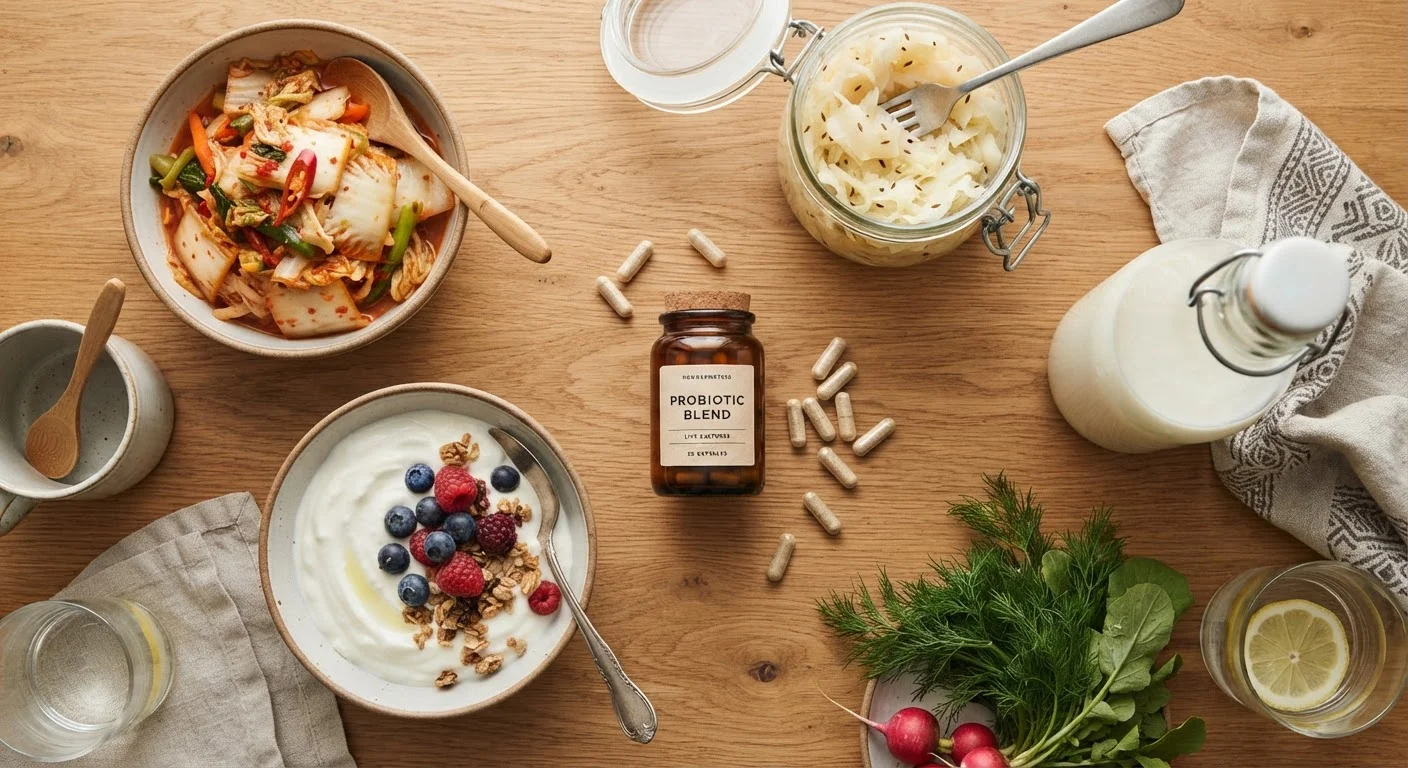
Key Takeaways
Option A
Fermented Foods
The whole-food, matrix-rich approach to microbiome support.
Best for: People seeking to build gut-friendly habits through everyday dietary patterns and diverse nutrient intake.
Option B
Probiotic Supplements
The targeted, standardized delivery of specific bacterial strains.
Best for: Individuals looking for a convenient, measurable dose of specific probiotic strains, often under clinical guidance.
If you want to support gut health through sustainable daily eating habits
Fermented Foods
Foods like yogurt, kefir, kimchi, and miso provide live cultures alongside fiber, vitamins, and bioactive compounds that work synergistically to nourish the microbiome.
If you need a specific probiotic strain for a clinically identified concern
Probiotic Supplements
Supplements allow precise delivery of researched strains at defined colony-forming unit (CFU) counts, which is particularly relevant following antibiotic use or for targeted digestive support under medical guidance.
If you're focused on the gut-brain connection and emotional wellbeing
Fermented Foods
Dietary patterns built around fermented and whole foods are most consistently linked to microbiome diversity, which research associates with improved mood markers and lower inflammation.
If dietary restrictions limit your access to fermented foods
Probiotic Supplements
For those who cannot tolerate dairy or certain fermented products, a high-quality supplement can provide an accessible alternative — though consulting a healthcare provider is recommended.
What Sets Fermented Foods Apart
Fermented foods — including yogurt, kefir, sauerkraut, kimchi, tempeh, and miso — are created through controlled microbial activity that transforms raw ingredients. This process produces live microorganisms alongside a complex matrix of organic acids, short-chain fatty acids, B vitamins, and bioactive peptides. It is this food matrix that distinguishes fermented foods from supplements.
Research suggests that these accompanying compounds may enhance the survival and colonization of beneficial bacteria in the gut. A landmark 2021 study published in Cell found that a high-fermented-food diet increased microbiome diversity and reduced markers of immune activation — outcomes not easily replicated by isolated strains. Diversity within the gut microbiome is considered a key indicator of resilience and overall digestive health.
For a broader look at how gut bacteria and daily lifestyle choices interact, see our guide to gut health habits.
| Criterion | Fermented Foods | Probiotic Supplements |
|---|---|---|
| Microbial diversity | High — multiple natural strains | Low — one or few specific strains |
| Nutrient co-factors | Present (vitamins, acids, peptides) | Generally absent |
| Dose precision | Variable, difficult to standardize | Standardized CFU counts |
| Evidence base | Strong for microbiome diversity | Strong for specific clinical uses |
| Accessibility | Widely available, dietary integration | Convenient; quality varies widely |
| Gut-brain research support | Broader dietary pattern evidence | Emerging psychobiotic research |
| Cost | Generally lower long-term | Can be significant ongoing expense |
Where Probiotic Supplements Have an Edge
Probiotic supplements provide live bacterial strains — most commonly Lactobacillus and Bifidobacterium species — in standardized doses measured in colony-forming units (CFUs). This precision is their primary advantage. When a clinician identifies that a patient would benefit from a particular strain, a supplement ensures delivery of a consistent, measurable quantity that would be difficult to achieve through food alone.
Evidence supports specific supplement use in well-defined contexts: reducing antibiotic-associated diarrhea, managing symptoms of irritable bowel syndrome (IBS), and supporting immune function in certain populations. However, not all supplements are equal. Strain specificity, CFU count, delivery mechanism (enteric-coated capsules improve survival through stomach acid), and product quality all significantly affect outcomes.
~38 trillion
Estimated microbial cells in the human gut
Current estimates suggest the human gut microbiome contains roughly as many microbial cells as human cells in the body, underscoring its systemic importance.
~90%
Of the body's serotonin produced in the gut
Research in enteric neuroscience indicates that the vast majority of serotonin synthesis occurs in the gastrointestinal tract, highlighting the gut-brain link.
19%
Increase in microbiome diversity
A 2021 study in Cell found participants on a high-fermented-food diet showed a 19% increase in microbiome diversity compared to a high-fiber control group.
It's worth noting that the regulatory environment for supplements in the U.S. means products vary widely in accuracy of labeling. Consulting a registered dietitian or gastroenterologist before choosing a supplement is strongly advisable, particularly for individuals managing chronic conditions.
The Gut-Brain Connection: Why This Comparison Matters for Mental Health
One of the most compelling reasons to care about gut health extends well beyond digestion. The gut and brain communicate through a bidirectional network known as the gut-brain axis — a pathway involving the vagus nerve, immune signaling, and neurotransmitter production. Approximately 90% of the body's serotonin is produced in the gut, and the composition of the microbiome appears to influence this and related systems.
Emerging research in nutritional psychiatry suggests that dietary patterns favoring fermented and fiber-rich foods are associated with lower rates of depression and anxiety, though causality is still being established. For context on how this communication system works, our article on the gut-brain axis and your mood covers the underlying mechanisms in depth.
Probiotic supplements have also been studied in psychobiotic research — a term for probiotics with potential mental health benefits — but this field is still in relatively early stages. Most evidence to date points to dietary patterns, rather than isolated supplementation, as the more robustly supported approach for mood-related outcomes. For a related perspective, see how the Mediterranean diet relates to mental wellbeing.
This article is for informational purposes only and does not constitute medical advice. Always consult a qualified healthcare professional before making significant changes to your diet or adding supplements, especially if you have an existing health condition.