

Key Takeaways
Option A
Plant-Based Diet
The broad, flexible category that excludes animal products.
Best for: Those transitioning away from animal products or seeking more dietary flexibility without strict food quality requirements.
Option B
Whole-Food Plant-Based Diet
The structured, nutrient-focused approach centered on unrefined plants.
Best for: Adults prioritizing nutritional density, long-term health outcomes, and minimally processed eating patterns.
If you're reducing animal products for the first time
Plant-Based Diet
The broader framework allows flexibility and a gentler transition, making it easier to sustain early dietary changes without immediate restrictions on food processing levels.
If nutritional density and long-term health outcomes are your primary goals
Whole-Food Plant-Based Diet
By centering unrefined plants, legumes, and whole grains, this approach consistently delivers higher fiber, micronutrient, and phytonutrient profiles per calorie.
If you're managing a chronic condition such as cardiovascular disease or type 2 diabetes
Whole-Food Plant-Based Diet
Research increasingly supports minimally processed plant-dominant diets in improving cardiometabolic markers, though any dietary shift for a health condition should be guided by a healthcare professional.
If convenience and social flexibility are important to your lifestyle
Plant-Based Diet
The wider category accommodates packaged foods, restaurant meals, and on-the-go eating, making it more practical for busy schedules.
What Each Term Actually Means
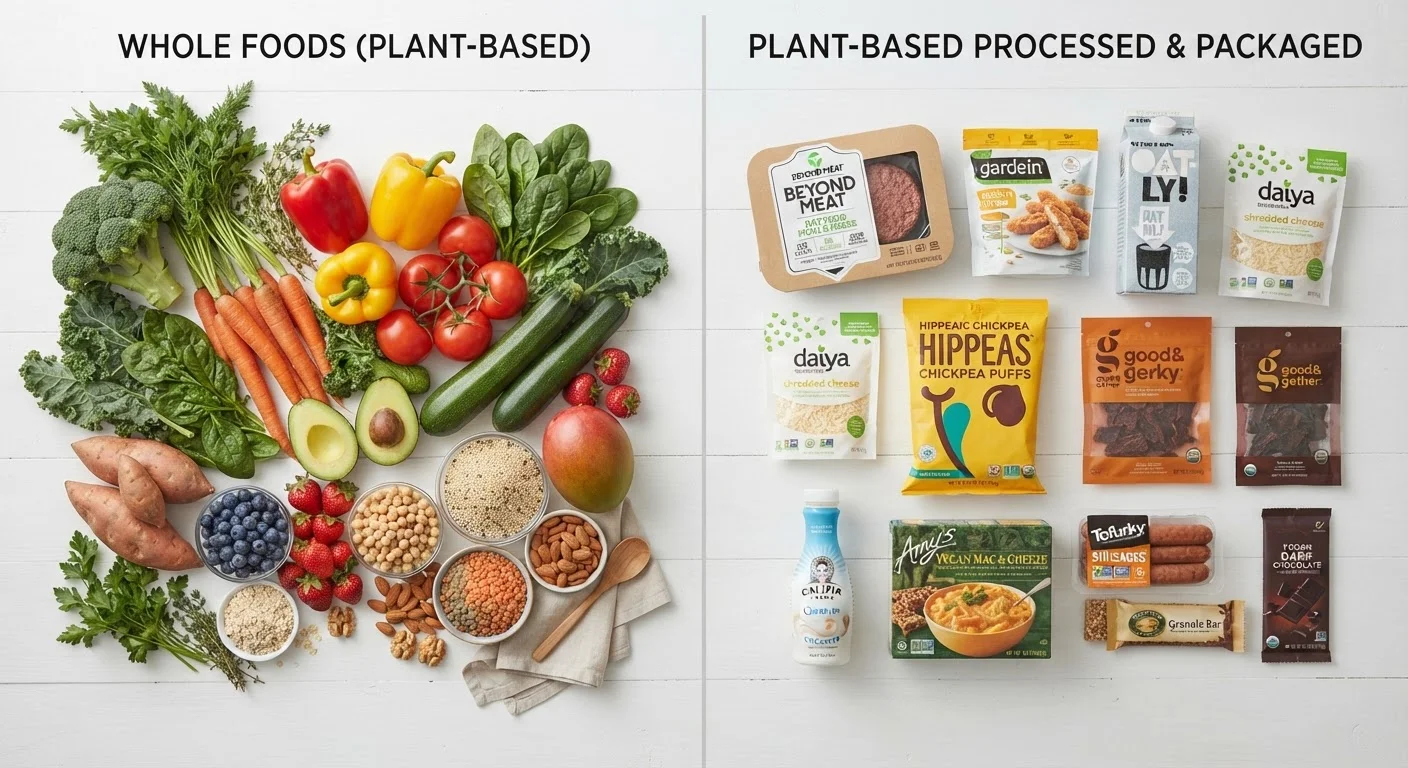
The phrase plant-based has become a widespread marketing and dietary label, but its meaning is remarkably elastic. In common usage, it simply refers to a diet that excludes or significantly limits animal-derived foods — meat, poultry, seafood, dairy, and eggs. What it does not specify is the quality or degree of processing of the plant foods included. A diet built on white-flour pasta, refined sugar, coconut oil, and highly engineered meat alternatives technically qualifies as plant-based.
A whole-food plant-based (WFPB) diet, by contrast, layers a second set of criteria on top of that exclusion: the foods consumed should be as close to their natural state as possible. Vegetables, fruits, legumes, whole grains, nuts, and seeds form the foundation. Refined oils, added sugars, and ultra-processed plant products are minimized or avoided. The distinction is not merely semantic — it has direct implications for nutrient density, fiber intake, and long-term dietary patterns. Understanding the spectrum from minimally to ultra-processed foods is a useful starting point for grasping why this gap matters in practice.
Where Nutritional Quality Diverges
The nutritional gap between these two approaches can be significant depending on food choices. A plant-based diet that leans heavily on packaged alternatives — such as refined grain crackers, flavored non-dairy beverages with added sugars, or sodium-dense mock meats — may provide fewer micronutrients and substantially less dietary fiber than a diet built around intact plant foods.
| Criterion | Plant-Based Diet | Whole-Food Plant-Based Diet |
|---|---|---|
| Defining principle | Excludes or limits animal products | Excludes animal products and processed foods |
| Processed foods allowed | Yes, including highly processed | Minimized or excluded |
| Refined oils and sugars | Permitted | Generally avoided |
| Typical fiber intake | Variable, depends on choices | Consistently high |
| Nutrient density | Inconsistent across food choices | Generally high per calorie |
| Ease of adoption | More flexible and accessible | Requires more meal planning |
| Evidence base | Mixed — depends on food quality | Strong for cardiometabolic outcomes |
Fiber is perhaps the most telling marker. Whole plant foods — particularly legumes, vegetables, and whole grains — are primary sources of both soluble and insoluble dietary fiber, which supports digestive health, glycemic regulation, and satiety. Processing often strips or reduces this fiber content. Similarly, phytonutrients (beneficial plant compounds such as polyphenols and flavonoids) are most concentrated in minimally processed forms of plant foods. Research on how whole versus ultra-processed foods affect mood and energy further illustrates why food quality — not just food category — shapes health outcomes.
Common Misconceptions Worth Addressing
One persistent misconception is that a plant-based label automatically confers health benefits. Nutritional science does not support this interpretation. The health associations frequently linked to plant-dominant diets in research literature — improved cardiovascular markers, lower rates of type 2 diabetes, better weight management — are generally drawn from studies examining dietary patterns rich in whole, unrefined plant foods, not from studies of plant-labeled convenience products.
Nutrient Gaps Exist in Both Approaches
Eliminating animal products — whether through a broad plant-based or strict whole-food plant-based diet — creates genuine risk of deficiency in vitamin B12, vitamin D, calcium, iodine, and long-chain omega-3s. These nutrients require intentional dietary planning or supplementation. Blanket assumptions that any plant-centered diet is automatically nutritionally complete are not supported by evidence. Always work with a healthcare provider or dietitian to assess your individual needs.
A second misconception is that whole-food plant-based eating is nutritionally complete without any attention to planning. Vitamin B12, vitamin D, iodine, calcium, zinc, and long-chain omega-3 fatty acids all require deliberate dietary strategy or supplementation when animal foods are excluded. This applies whether someone follows a broad plant-based approach or a strict WFPB pattern. Anyone making significant dietary changes — particularly those in special populations such as pregnant individuals, older adults, or those managing chronic conditions — should consult a registered dietitian or qualified healthcare provider before doing so.
Dietary patterns and their relationship to cognitive performance and mood stability offer additional context for how food quality influences wellbeing beyond physical metrics.
Choosing the Right Approach for Your Goals
Neither framework is inherently superior for every person or every context. A broad plant-based approach may serve as a practical entry point for someone navigating the early stages of reducing animal product consumption — it allows room for processed convenience foods that ease the transition without demanding an immediate overhaul of cooking habits or food access. Building healthier eating habits incrementally is often more sustainable than attempting sweeping change overnight.
For those whose primary motivation is nutritional quality, metabolic health, or managing a chronic condition, a whole-food plant-based pattern offers a more structured — and evidence-aligned — framework. It encourages a dietary environment naturally higher in fiber, antioxidants, and complex carbohydrates while lower in refined ingredients that contribute little nutritional value. Reviewing how WFPB compares to other evidence-supported patterns like Mediterranean and DASH can help contextualize where it fits within broader nutrition science.
~28g
Daily fiber intake in typical WFPB diet
Research on whole-food plant-based dietary patterns consistently shows fiber intakes meeting or exceeding the Adequate Intake set by the National Academies, compared to lower averages in the general U.S. population.
~17g
Average daily fiber intake in the U.S.
According to data from the USDA, most Americans consume roughly half the recommended daily fiber intake, a gap that whole-food plant-based eating patterns are particularly well-positioned to address.
This article is for general informational and educational purposes only and does not constitute medical or dietary advice. Individual nutritional needs vary. Please consult a qualified healthcare professional or registered dietitian before making significant changes to your diet.