

Key Takeaways
Option A
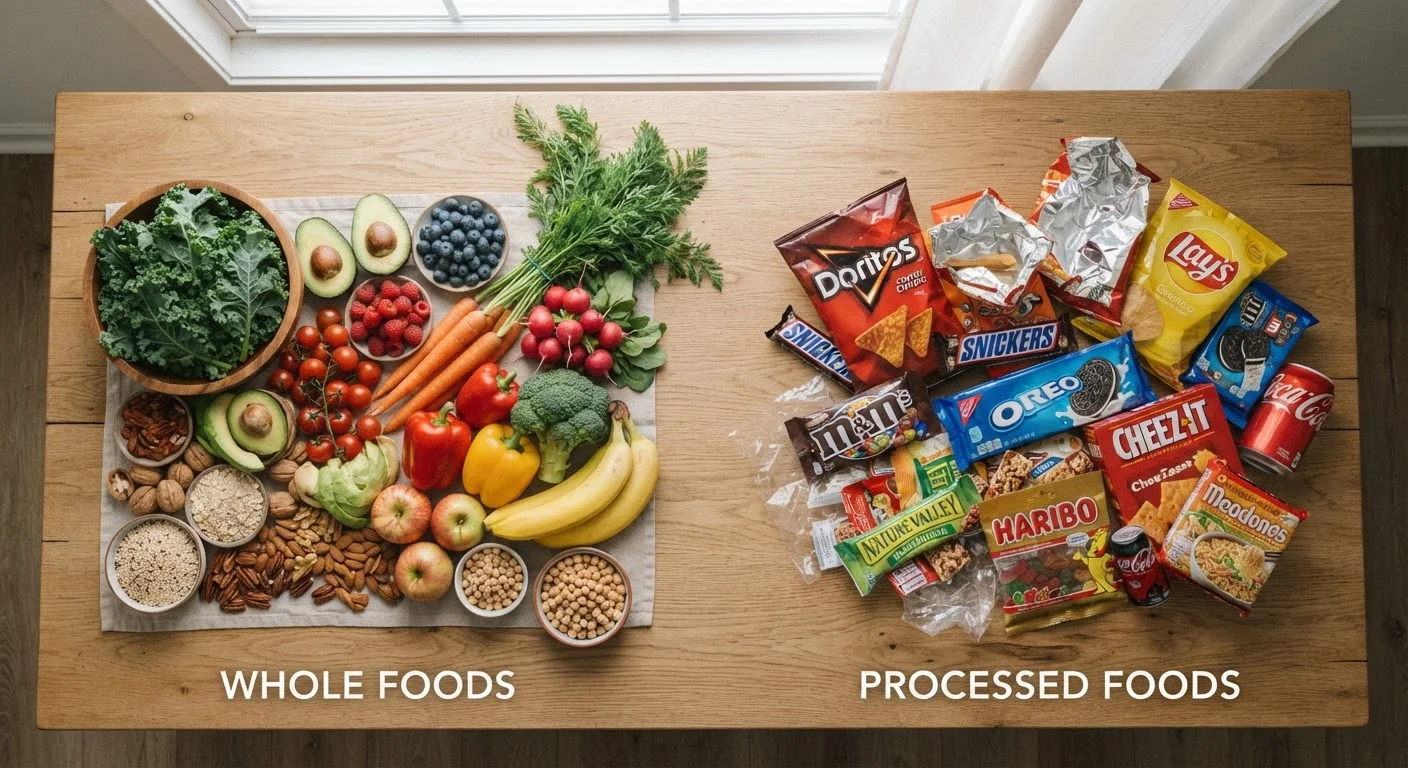
Whole Foods
The nutrient-dense, minimally altered foundation of a mood-supportive diet.
Best for: Individuals seeking sustained energy, stable mood, and long-term mental and physical wellness through dietary quality.
Option B
Ultra-Processed Foods
The convenient, heavily engineered option linked to nutritional gaps and mood variability.
Best for: Understanding the dietary patterns associated with energy crashes, inflammation, and disrupted gut-brain signaling.
If you want to support stable mood and sustained energy throughout the day
Whole Foods
Whole foods provide fiber, phytonutrients, and key micronutrients that help regulate blood sugar and support the neurotransmitter pathways linked to mood stability.
If you're trying to understand what dietary patterns to reduce for better mental wellbeing
Ultra-Processed Foods
Studying the profile of ultra-processed foods — excess added sugars, refined fats, artificial additives — helps clarify which nutritional gaps to address in your overall diet.
If you're managing stress and looking for dietary strategies to complement other self-care practices
Whole Foods
Diets rich in vegetables, legumes, whole grains, and lean proteins are consistently associated with lower inflammation markers and better psychological resilience in the research literature.
If you're a caregiver or parent seeking to reduce ultra-processed food intake in your household
Whole Foods
Gradually shifting toward whole-food meals supports more consistent nutrient intake for all ages; consult a pediatric or family dietitian for tailored guidance.
Defining the Two Ends of the Food Processing Spectrum
Not all processing is created equal. Understanding what distinguishes whole foods from ultra-processed options is foundational before examining their mental health implications. For a deeper breakdown of this spectrum, see Whole Foods vs Processed Foods: Understanding the Real Difference.
Whole foods are those consumed close to their natural state — think fresh vegetables, fruit, legumes, whole grains, eggs, and nuts. They may undergo minimal processing such as washing, freezing, or cooking, but their fundamental nutritional structure remains intact.
Ultra-processed foods (UPFs) are defined by researchers using frameworks like the NOVA classification system as formulations containing multiple industrial ingredients — preservatives, emulsifiers, artificial flavors, added sugars, and refined fats — with little to no whole-food content. Think packaged snack cakes, carbonated soft drinks, flavored chips, and reconstituted meat products.
The critical distinction isn't convenience versus effort — it's nutritional integrity. UPFs are engineered for palatability and shelf life, often at the expense of fiber, micronutrients, and the natural food matrix that affects how nutrients are absorbed and used.
| Criterion | Whole Foods | Ultra-Processed Foods |
|---|---|---|
| Nutrient density | High — vitamins, minerals, fiber intact | Low — often micronutrient-depleted |
| Fiber content | Naturally high; supports microbiome | Typically very low or absent |
| Added sugars | Minimal to none | Often high; drives glucose spikes |
| Inflammatory potential | Generally anti-inflammatory | Associated with elevated inflammation markers |
| Gut microbiome impact | Supports microbial diversity | May reduce diversity over time |
| Mood research association | Linked to lower depression risk | Associated with higher psychological distress |
| Blood sugar regulation | Supports stable glucose levels | Promotes rapid spikes and crashes |
| Processing level (NOVA) | Group 1 — unprocessed or minimal | Group 4 — industrial formulations |
How Food Quality Influences Brain Chemistry and Mood
The relationship between diet and mood is mediated by several overlapping biological pathways. Key among these is the gut-brain axis — the bidirectional communication network linking the gastrointestinal system to the central nervous system via the vagus nerve, immune signaling, and microbial metabolites.
Whole foods, particularly those rich in fiber and polyphenols, support a diverse gut microbiome. A well-nourished microbiome produces short-chain fatty acids and contributes to the synthesis of neurotransmitter precursors, including those involved in serotonin pathways — a significant proportion of which originate in the gut. For a reference guide to specific nutrients involved in brain chemistry, see Nutrients That Play a Role in Brain Chemistry.
Ultra-processed foods tend to have the opposite profile: low in fiber, high in added sugars, and often lacking in the micronutrients — such as magnesium, B vitamins, and zinc — that are cofactors in neurotransmitter synthesis. High sugar intake, in particular, can drive repeated blood glucose spikes and crashes, contributing to irritability, fatigue, and difficulty concentrating.
Correlation vs. Causation in Diet-Mood Research
Most studies linking ultra-processed food intake to poorer mood outcomes are observational, meaning they track associations rather than proving direct cause and effect. Factors like socioeconomic stress, sleep quality, and physical activity often co-occur with dietary patterns, making it difficult to isolate food as the sole variable. Researchers continue to refine study designs — including randomized trials — to better establish the direction and strength of these relationships.
Chronic low-grade inflammation is another relevant mechanism. Diets dominated by UPFs are associated with elevated inflammatory markers such as C-reactive protein. Neuroinflammation is increasingly recognized as a contributor to depressive symptoms, though establishing direct causation in humans remains an active area of research.
What the Research Shows — and Where It Stops Short
Several large-scale observational studies have found consistent associations between higher ultra-processed food consumption and increased risk of depressive symptoms, anxiety, and poorer self-reported mental health. A frequently cited 2022 analysis published in JAMA Network Open found that adults with high UPF intake reported elevated rates of psychological distress compared to lower-consumption groups.
~33%
Higher depression risk with high UPF diets
A 2023 meta-analysis published in Nutritional Neuroscience found that high ultra-processed food consumption was associated with approximately 33% greater odds of depression compared to low consumption.
~58%
Share of US calories from ultra-processed foods
Research drawing on NHANES data has estimated that ultra-processed foods account for more than half of total daily caloric intake in the average US adult diet.
95%
Serotonin produced in the gut
According to findings in enteric neuroscience, approximately 95% of the body's serotonin — a neurotransmitter closely tied to mood — is synthesized in the gastrointestinal tract, underscoring diet's relevance to mental health.
On the other side, dietary patterns rich in whole foods — vegetables, fruits, whole grains, legumes, fish, and nuts — are associated with lower depression risk. This relationship is explored in depth in the context of the Mediterranean diet. For an honest assessment of that evidence, see The Mediterranean Diet and Mental Wellbeing: What the Research Actually Says.
However, important caveats apply. Most research in this area is observational, meaning it identifies correlations rather than proving causation. People experiencing depression may independently gravitate toward comfort foods high in sugar and fat — making directionality difficult to establish. Randomized controlled trials examining diet quality and mood outcomes exist but are limited in scale and duration. The science is promising and directionally consistent, but not yet definitive.
For a broader look at how eating patterns relate to cognitive and emotional function, see Eating to Support Mental Clarity: Dietary Patterns Worth Understanding.
Practical Perspective: Making Dietary Shifts That Support Wellbeing
Understanding the science is useful — but sustainable dietary change is what actually moves the needle. Rather than framing this as strict dietary elimination, a more evidence-aligned approach involves gradually increasing whole-food density in your meals and reducing reliance on UPFs as dietary staples.
Some practical starting points supported by nutritional research:
- Prioritize dietary variety: A broad range of vegetables, fruits, whole grains, and protein sources supplies the diverse nutrients that support both physical and mental health.
- Consider gut-supportive foods: Fermented foods like yogurt, kefir, and kimchi contribute to microbiome diversity. For a science-grounded comparison of food-based versus supplement approaches, see Fermented Foods vs. Probiotic Supplements: What Actually Supports Gut Health?.
- Examine omega-3 intake: Fatty fish, walnuts, and flaxseed are whole-food sources of omega-3 fatty acids, which have been studied in relation to mood. For a grounded look at this evidence, see Omega-3 Fatty Acids and Mood: Separating Evidence From Enthusiasm.
- Read labels with context: Not all packaged foods are ultra-processed. Understanding the difference between plant-based and whole-food plant-based diets illustrates how marketing language and nutritional quality can diverge.
This article is intended for general informational and educational purposes only and does not constitute medical or nutritional advice. Individual dietary needs vary. Please consult a registered dietitian or qualified healthcare professional before making significant changes to your diet, especially if you are managing a health condition or taking medication.